

FAQ
What is shot blasting abrasive?
ABRASIVES
Types, grit size and hardness by application
Shot blasting abrasive is the material projected in shot blasting and shot peening processes. It is the element that, on impacting the part surface, produces cleaning, the roughness profile or compressive stresses depending on the process objective. Abrasive quality directly determines process quality and cost.
Abrasive is manufactured in different materials, granulometries and hardnesses depending on the application. The most widely used types in industry are carbon steel spherical (shot) and angular (grit) for general shot blasting and shot peening applications; stainless steel shot for processes involving stainless steel, aluminum and materials that cannot be contaminated with iron; glass beads for delicate surface finishes and low-intensity shot peening on sensitive materials; and aluminum oxide for applications requiring high-hardness mineral abrasives.
Granulometry — particle size — is classified according to SAE J444 for spherical shot and SAE J827 for angular grit. The size code (S-110, S-170, S-230, S-280, S-330, S-390, S-460, S-550, S-660, S-780) indicates the size range expressed in mesh sizes. The higher the number, the larger the particle diameter.
Abrasive hardness determines its service life and the roughness profile it generates. Carbon steel shot is manufactured in three hardness levels: H (392–528 HV), P (430–550 HV) and PE (on request), with PE hardness specific to shot peening applications.
CYM Materiales supplies carbon steel spherical and angular shot, stainless steel shot, glass beads and aluminum oxide for all shot blasting and shot peening processes.
KEEP EXPLORING
Related equipment and content
FAQ
What is shot blasting?
Industrial shot blasting — process, applications and equipment
Read more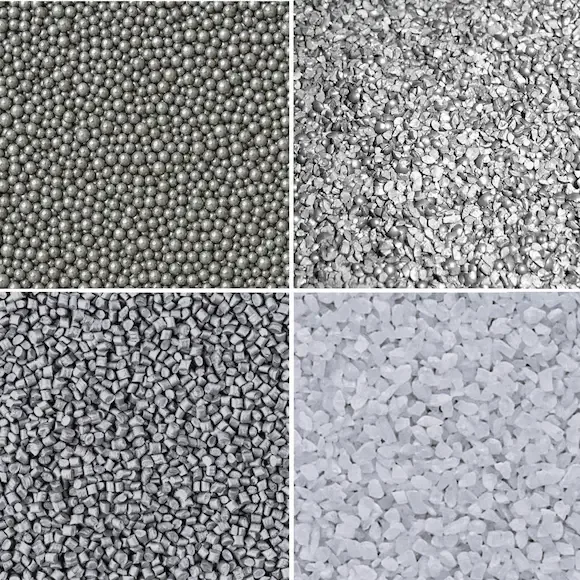
FAQ
How to choose the best blasting abrasive
Which abrasive to use by material and process
Read more
FAQ
Why replace sand with metallic shot?
Metallic shot vs sand — operational and economic advantages
Read moreInstallations
Equipment in operation
videos
Equipment in action
ABRASIVE SELECTION
Not sure which abrasive your process needs?
CYM Materiales helps you define it
Our technical team reviews the part material, the available equipment, the finish you are after and the applicable standard, and recommends the right type, size and hardness. Get in touch, with no obligation.
REQUEST ADVICEPublished: June 2026