
Technical article
Why shot peening must be automatic and controlled
PROCESS CONTROL
Repeatability, traceability and why an “eyeballed” process fails on fatigue parts
Shot peening has an uncomfortable trait: it cannot be seen. Unlike a weld or a machined surface, a badly peened part looks the same as a well-peened one. The defect stays invisible until the part fails by fatigue in service, which is exactly the failure mode the process was meant to prevent. This is why, on components where fatigue matters, shot peening is not “throwing shot at a part”: it is a process that must be specified, measured and repeatable. This article explains what that means and why a manual or “eyeballed” process is not enough.
What a “controlled” process means
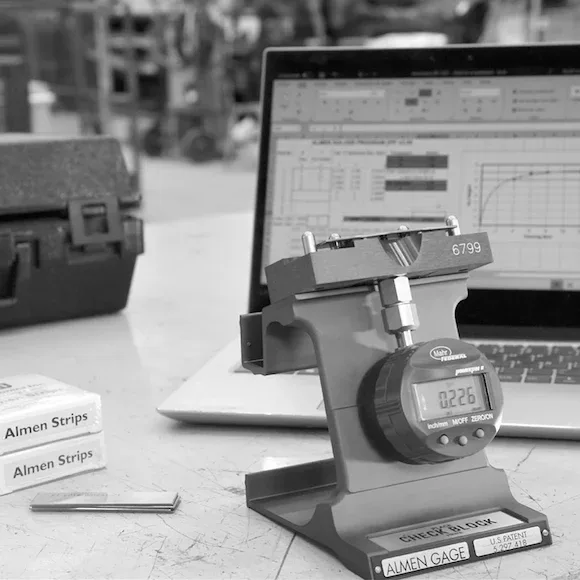
Controlling shot peening means setting and verifying its two result variables on every part: intensity, measured with an Almen strip, and coverage, the percentage of surface actually impacted. It is not enough to measure them once on a test piece: the process is controlled when every component that comes out receives that same intensity and that same coverage. For the detail of what Almen intensity and coverage are, see the introduction to shot peening article.
How it is controlled on a CYM machine
On a CYM machine, that control is made up of concrete systems. The projection parameters are monitored and kept fixed: shot flow rate permanently, wheel speed (RPM) on wheel machines, and air pressure and flow on compressed-air machines. But there is one variable an “eyeballed” process never controls: the condition of the abrasive itself. Degraded shot, or shot with excess fines, changes the result even if every other parameter is fixed. That is why the machine integrates a cleaning and classification system that keeps the operating mix stable throughout the cycle. In its automatic version, the system regulates the formation of the shot curtain and controls the air flow, with a warning on the HMI at any deviation. On compressed-air machines, vibrating screens are also added to classify the shot within a defined size range. To this are added cycle time, controlled part or robot movement and shot replenishment. Everything is logged per part or per batch.
Why automatic
Automation is what turns “blasting” into “blasting to specification”. A manual process depends on the operator: their steadiness, the nozzle distance and angle, fatigue, the shift. That variability is tolerable in surface cleaning, but not in shot peening, where an area with less coverage or less intensity is left without the residual compression layer and becomes the point where the crack starts. What is a cosmetic defect in cleaning is, on a fatigue part, the origin of failure.
It is not shot peening: it is blast cleaning
Controlled shot peening is not a bureaucratic requirement or the demand of one particular standard: it is what distinguishes shot peening from plain blast cleaning. If intensity and coverage are not measured, fixed and repeatable part to part, there is no shot peening: there is shot hitting a surface with no guarantee of result. Industry standards, such as AMS 2430 in aerospace and automotive, do not invent that requirement: they formalize it, demanding that the process be automatic, controlled and traceable. This is why, on components where fatigue defines service life, a manual or “eyeballed” process is not a cheaper version of shot peening: it is something else.
CONCLUSION
What is not controlled cannot be guaranteed
On parts where fatigue defines service life, shot peening does not allow “eyeballing”. The difference between a well-peened part and a badly peened one is invisible until it fails, and by then it is too late. An automatic and controlled process does not remove that uncertainty on faith: it removes it by measuring, fixing and logging. As a manufacturer, CYM designs machines that ensure repeatable intensity and coverage; the final fatigue performance also depends on the material, the heat treatment and the design of the part, but the machine guarantees what is under its control, in a repeatable and traceable way. That is exactly the ground where a manual process cannot compete.
Published: July 2026
KEEP EXPLORING
Related equipment and content
Installations
Equipment in operation
videos
Equipment in action
Special Projects
Can't find the equipment you need?
CYM Materiales develops it.
Our Engineering and Sales team works alongside the client to design a custom solution, reducing operating costs and maximizing productivity. Every project starts with a detailed technical assessment and ends with a machine built and tested at our plant
REQUEST A CUSTOM PROJECT