
Technical article
Dust collection in cement and aggregates
CONSTRUCTION MATERIALS
Silo venting, loading and dispatch: the challenge of dust that sets
Cement dust has a peculiarity it shares with almost no other industrial dust: it is hygroscopic and it sets. On contact with moisture it does not merely cake as an organic dust would; it hardens on whatever surface it has settled on. That single characteristic changes the design of the entire capture system, from the filter medium to the geometry of the hopper. In aggregates the problem is different but just as concrete: large volumes of abrasive mineral dust in plants that, increasingly, operate close to populated areas.
The handling points: from silo to truck
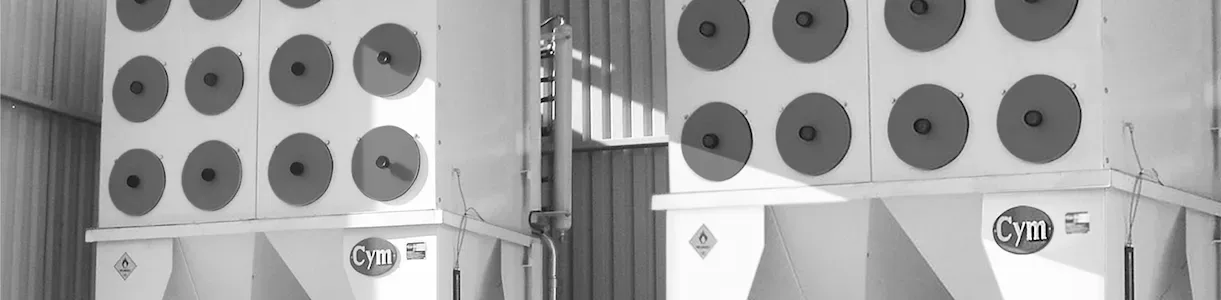
Capture in cement and aggregates concentrates on the points where material is stored, transferred and dispatched. Silo venting is the most characteristic: every time a tanker truck unloads pneumatically, the displaced air must leave filtered, and that unit is mounted on the silo itself. Added to this are bulk loading through telescopic chutes, bagging and palletizing, transfers between belts, screws and elevators, and ready-mix concrete plants, where filling the weigh batcher displaces cement-laden air. At the quarry face —crushing, screening and transport— the capture logic is that of any mineral operation, and is developed in the dust collection in mining article.
The dust that sets
This is the central difference from any other sector. When cement dust takes up moisture, the cleaning pulse stops working: the material hardens on the filter medium and saturates it irreversibly, and in the hopper it forms bridges that block discharge even when the unit is capturing well. This is why the design defends against moisture on several fronts at once: filter media with a hydrophobic treatment or membrane, steep-walled hoppers with fluidizers or vibrators so the material does not bridge, and insulation or heat tracing to keep the unit above the dew point. Moisture is not an operational detail: it is the design variable.
Inert but not harmless
Unlike grain, wood or fine metal dusts, cement and aggregate dust is not combustible: it needs no deflagration venting or explosion isolation in the ducts, measures that are mandatory in other sectors and are explained in the FAQ on whether a dust collector can explode. That does not make it harmless. Aggregates contain crystalline silica, whose respirable fraction causes silicosis with prolonged exposure, and cement is strongly alkaline and irritating to the airways, skin and eyes. The order of control is the usual one: capture at the source as the engineering control, and personal protection as the last barrier.
CONCLUSION
In cement the enemy is moisture
A cement extraction system can be correctly sized in airflow and in filtration area and still fail, if it did not account for the fact that the dust it captures sets. Moisture is the variable that defines the success of the installation: it defines the filter medium, the geometry of the hopper, the need for insulation and even the startup procedure. Defining it from the design stage is what keeps the collector from turning into a block of hardened material a few months into operation.
Published: July 2026
KEEP EXPLORING
Related equipment and content
Technical article
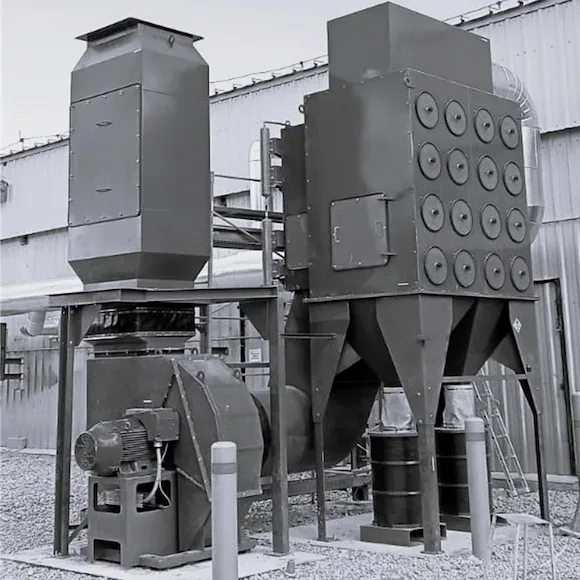
Dust collection in mining
Altitude, abrasion and scale: why a standard system is not enough
Read more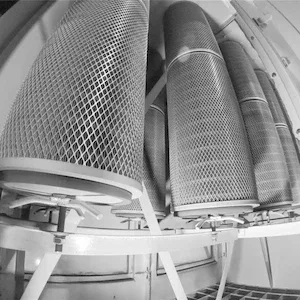
TECHNICAL ARTICLES
Cartridge or bag filter dust collector
How to choose based on the type of dust
Read more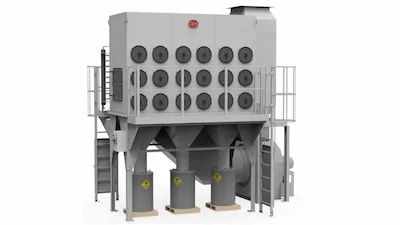
cart-h - cart-v line
Cartridge dust collectors
0.5 microns filtration at 99.9%, continuous pulse cleaning and horizontal or vertical configuration.
Read moreSpecial Projects
Can't find the equipment you need?
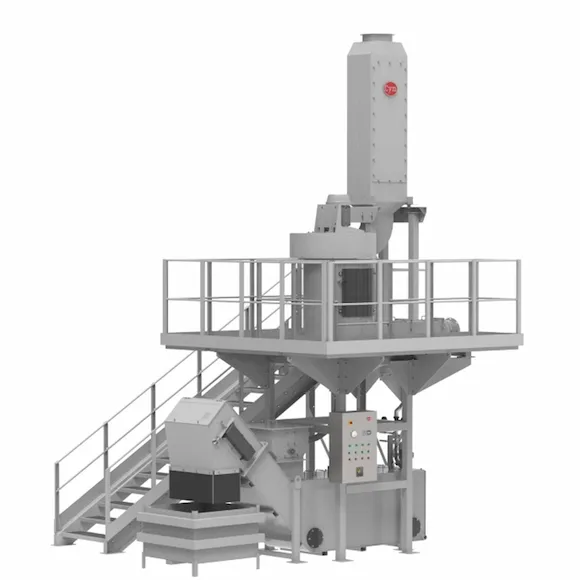
CYM Materiales develops it.
Our Engineering and Sales team works alongside the client to design a custom solution, reducing operating costs and maximizing productivity. Every project starts with a detailed technical assessment and ends with a machine built and tested at our plant
REQUEST A CUSTOM PROJECT