
Technical article
Dust collection in grain and port facilities
AGRIBUSINESS
From storage to ship: dust capture and explosion risk
In grain handling, dust is not an environmental nuisance: it is fuel. Every ton moved releases fine particles that disperse into the air and settle on structures, and that deposit is the material that feeds a fire or an explosion. That is why, in grain and port facilities, dust collection serves several purposes at once: it protects people's health and the environment, it removes the fuel before it builds up, and it sustains the food-safety standards buyers demand.
Where the dust is generated: the transfer points
Grain dust is not released uniformly: it appears every time the material changes container or direction. The critical points are truck, railcar or barge unloading; conveyor belts and their transfer points; bucket elevators; the filling and emptying of silos and bins; dryers; and, at a port terminal, ship loaders. Each of those points requires its own capture, sized to the flow it handles. Designing the extraction as a “general ventilation” of the room does not work: the dust must be taken where it is produced.
The critical point: where it starts and where it spreads
Explosion risk in a grain plant has a known geography. The bucket elevator is the most frequent primary ignition point: a closed volume, with dust in suspension and heat sources from friction or belt misalignment. But the greatest destruction is almost never caused by that first deflagration, but by the dust that was deposited on beams, galleries, walkways and ducts: the pressure wave lifts it and forms a cloud that, when ignited, produces a secondary explosion far more severe than the first. Grain dust is a combustible dust classified in the explosivity tables; the mechanism by which a dust explosion occurs and its severity are developed in the dust explosion risk article.
The other driver of investment: quality and food-safety audits
Explosion prevention is not the only reason port terminals and oilseed crushing plants have invested in dust collection in recent years. Buyers in Europe and Asia audit their suppliers ever more strictly, and certification schemes such as GMP+ or HALAL require facilities where the cargo is not contaminated during handling. Organic dust deposited on structures, conveyors and galleries is a favorable medium for microbial growth and a route of cross-contamination between batches, so dust control has stopped being a housekeeping matter and become an auditable quality requirement. In practice, terminals are adopting standards typical of the food industry: capture at the source and the absence of accumulated dust are part of what the auditor checks.
Why a bag filter, and why not wet
Grain dust is fibrous, light and usually carries moisture from the material itself: it is exactly the type of dust that cakes and saturates a pleated medium. The fabric of the bags tolerates it better and releases the dust cake more effectively with each cleaning pulse, and its low cost per square meter of filter media is decisive in installations that require very large filtration areas. That is why grain and bulk handling is the natural territory of the bag filter. The choice between the dry technologies and the sizing criterion are developed in the corresponding articles.
One distinction that is often confused is worth clarifying. That a dust is combustible does not mean it must be captured wet. The wet scrubber is the solution for combustible metal dusts —aluminum, magnesium, titanium—, where water removes the ignition risk. By contrast, the combustible organic dust of grain is captured dry, with a bag filter, but that collector must be protected against explosion. The technology does not change: what changes is the protection equipment that goes with it.
The collector must also be protected
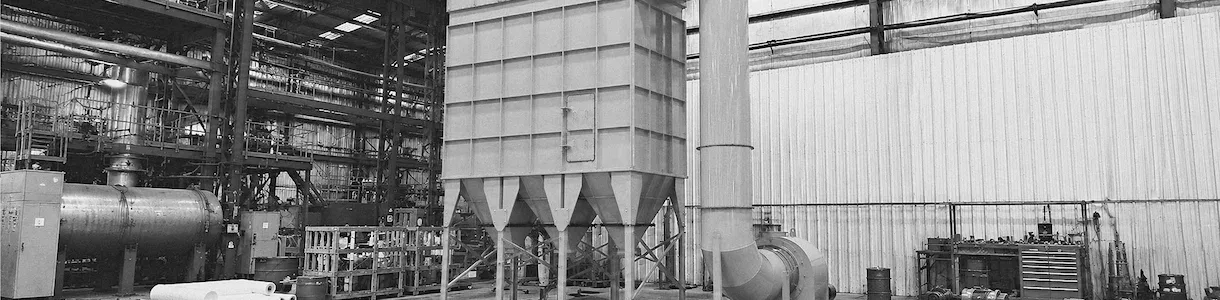
A collector loaded with combustible dust is, by definition, a confined volume with flammable material in suspension: it is the equipment most likely to contain a deflagration. That is why capturing well is not enough; the collector itself and the network that connects it to the plant must be protected. The two central measures are deflagration venting, which releases the explosion pressure in a controlled way toward a safe place and keeps the equipment from being destroyed, and explosion isolation in the extraction ducts, which prevents the flame front from traveling through the network and setting off a secondary explosion in the rest of the installation. The international reference standards are NFPA 61 for agricultural and food-processing facilities, NFPA 68 for deflagration venting —which specifically covers the venting of bag, filter or cartridge collectors— and NFPA 69 for prevention. The starting point in every case is a dust hazard analysis. These are United States standards: each country must verify its local regulation. CYM Materiales supplies collectors with deflagration venting and explosion isolation, sized for the application.
Extraction is prevention, not cleaning
It is worth stressing the order. Explosion protection mitigates the consequences of an event; extraction prevents that event from having anything to feed on. Every kilo of dust the system removes at the source is a kilo that does not settle on the structures and will not be available for a secondary explosion. That is why capture and good housekeeping are not accessory expenses in a grain plant: they are the first line of prevention, prior to any protection device.
CONCLUSION
Capturing well and protecting the equipment are the same investment
In grain and port facilities, dust collection is not justified only by the work environment or outdoor emissions: it is justified because the captured dust is the same dust that can destroy the plant and the same dust that compromises the quality of the cargo. Sizing the system to the real transfer points, choosing the right technology and protecting the collector with venting and isolation are parts of a single engineering decision. Defining the dust and its behavior first —through a hazard analysis— is what makes it possible to get that decision right.
KEEP EXPLORING
Related equipment and content
Installations
Equipment in operation
Special Projects
Can't find the equipment you need?
CYM Materiales develops it.
Our Engineering and Sales team works alongside the client to design a custom solution, reducing operating costs and maximizing productivity. Every project starts with a detailed technical assessment and ends with a machine built and tested at our plant
REQUEST A CUSTOM PROJECTPublished: July 2026