
Technical article
Dust collection in mining
MINING
Altitude, abrasion and scale: why a standard system is not enough
Mining in Argentina is expanding into the high Andes and the Puna, and with it come operating conditions that a standard dust collection system does not account for. Above 4,000 meters the air has little more than half the density it has at sea level, the ore is abrasive and wears down whatever it touches, and operations combine dust sources that differ widely from one another. Designing dust collection for a mine is not a matter of applying a catalog: it means correcting the calculation for the real conditions of the site.
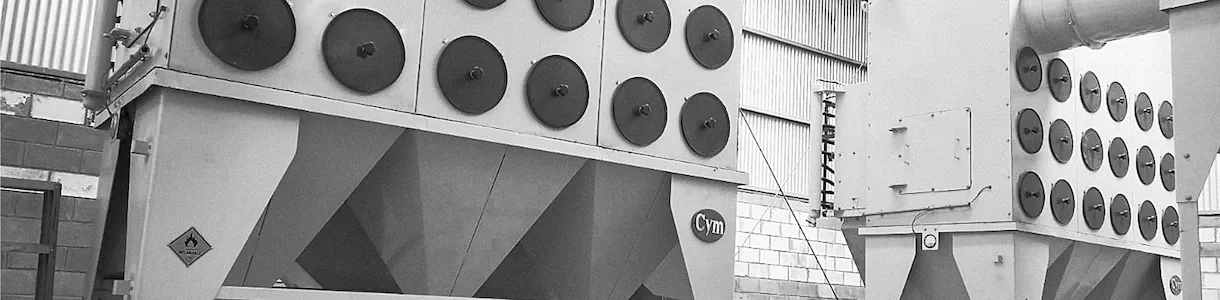
A case at 4,500 meters. At the Veladero mine (Minera Andina del Sol, San Juan), CYM installed two cartridge dust collectors —of 288 and 384 m³/min— for dust capture in the metallurgical and chemical laboratories. At that altitude no unit can be selected from a catalog: the fan–motor assembly requires a sizing criterion of its own, which CYM developed from its own engineering research for high-altitude operations. The units also incorporate automatic airflow control, which sustains capture as the filter loads and reduces consumption when not all extraction points are active.
The sources: from crushing to the laboratory
A mining operation generates dust in two different worlds. In the process circuit —primary and secondary crushing, screening, conveyor transfer points, stockpiles and truck or train loading— the dust is abundant, coarse and abrasive, and the airflows are large; the same capture logic applies at the quarry face in cement and aggregates . By contrast, the dust is fine, the scale is smaller and the demands are different: analytical precision and no contamination between samples. A single site therefore needs systems sized with different criteria depending on the sector.
Altitude changes the calculation
This is the factor that causes the most errors and is the least considered. Air density falls with altitude: at 4,000 meters it is around 60% of that at sea level, and it keeps dropping above that mark. Because fan curves are published at standard conditions —sea level and normalized temperature—, a unit chosen from a catalog moves far less mass of air than its data sheet indicates, and the capture falls short even though “the numbers added up”. Correcting for altitude is not a minor adjustment or a rule of three: it is the difference between a system that works and one that was bought well and performs poorly.
A case at 4,500 meters. At the Veladero mine (Minera Andina del Sol, San Juan), CYM installed two cartridge dust collectors —of 288 and 384 m³/min— for dust capture in the metallurgical and chemical laboratories. At that altitude no unit can be selected from a catalog: the fan–motor assembly requires a sizing criterion of its own, which CYM developed from its own engineering research for high-altitude operations. The units also incorporate automatic airflow control, which sustains capture as the filter loads and reduces consumption when not all extraction points are active.
The laboratories: precision and cross-contamination
In a mining laboratory, dust compromises more than health: it compromises the result of the assay. Sample preparation —crushing, pulverizing, sieving, splitting— generates fine dust that, if not captured at the source, settles on surfaces and equipment and ends up contaminating the next sample. In an operation where ore grades drive million-dollar decisions, cross-contamination between samples is not a housekeeping problem but a matter of analytical reliability. That is why laboratory capture demands high efficiency on fine particles and point capture at each piece of equipment, rather than large airflows.
Abrasion: what wears the system down
Ore dust is abrasive, and a poorly designed extraction system consumes itself. Erosion attacks duct elbows and branches, the fan impeller and the filter media itself, with wall losses that end in perforations and leaks. Control comes from keeping duct velocities within a range that conveys the material without eroding it, and from providing thicknesses and protection at critical points. When the coarse-material load justifies it, pre-separation with cyclones is added, according to each operation's requirement.
Silica: the health risk across the whole operation
Rock contains crystalline silica, and when crushed, ground or pulverized it releases respirable particles whose prolonged inhalation causes silicosis, an irreversible lung disease. It is present throughout the circuit and also in laboratory sample preparation. The order of control is the one that applies to any hygiene risk: capture at the source is the primary engineering control, and personal protective equipment is the last barrier, not the first. The operator's respiratory protection equipment is developed in the specific article.
Scarce water: why the dry route
In the high Andes and the Puna, water is a critical resource, subject to social license and use restrictions. That conditions the solutions: both dust suppression by spraying and capture with a wet scrubber involve a consumption that is hard to justify in those sites. Well-sized dry filtration —with the right filter media and a cleaning system that sustains the airflow— is, in most cases, the reasonable answer. The wet scrubber is reserved for situations where the type of dust requires it, as developed in the corresponding article.
CONCLUSION
The system does not fail because of the technology, it fails because of the context
In mining, filtration technology is rarely the problem: the problem is the context in which it is installed. Altitude forces you to correct the calculation, the abrasiveness of the ore forces you to design against wear, and the coexistence of very different sources —from crushing to the laboratory— forces you to size by sector and not as a block. A system designed with those three criteria is the one still capturing five years on; one chosen from a catalog starts failing much sooner.
KEEP EXPLORING
Related equipment and content
TECHNICAL ARTICLES
Airflow and filtration velocity
What determines the size of a dust collection system
Read more
TECHNICAL ARTICLES
Cartridge or bag filter dust collector
How to choose based on the type of dust
Read more
CART. MANGAS Y FILTROS HUMEDOS line
Dust collection
Cartridge collectors, wet filters and bag collectors for industrial processes.
Read moreInstallations
Equipment in operation
Special Projects
Can't find the equipment you need?
CYM Materiales develops it.
Do you need to size dust collection for a high-altitude mining operation? Our Engineering department has experience with installations above 4,000 meters and can assess your case.
Talk to EngineeringPublished: July 2026