
Technical article
How to specify a plate rolling machine
METAL FORMING
Material, thickness, width and minimum diameter: the four variables that define the machine
Choosing a plate rolling machine does not start with the equipment, but with the part you want to produce. The same machine that comfortably handles a mild-steel shell can fall short on that same shell in high-strength steel, and one that is more than enough for thin plate may not reach the minimum diameter a pressure vessel demands. The right specification is defined by four variables —material, thickness, width and minimum diameter—, not by the model name. This article explains what each one looks at and why, so you reach the enquiry knowing what to ask for.
Start with the material, not the machine
A plate roll's capacity is not an absolute number: it depends on the material to be bent. Two properties rule: yield strength and tensile strength. A high-yield steel resists more and springs back more when the pressure is released (springback), so it demands more force for the same thickness than mild steel. That is why catalog capacities are always stated for a reference material: rolling stainless or high-strength steels on a machine rated for mild steel reduces the real maximum thickness it can handle. The material is the first question, not a detail.
Thickness and width: capacity and length
Thickness defines the machine's capacity, and width defines its length. That is precisely why plate rolls are named by thickness times length: it is the summary of what they can do. Plate width not only sets the useful length of the rolls: it also conditions the minimum achievable diameter, because the wider the part, the harder it is to close it into small diameters. Defining the real maximum thickness and width of the work —not the usual ones— is what prevents buying a machine that falls short the day the big job comes in.
The minimum diameter you need to close
Every plate roll has a minimum diameter below which it cannot close a part, and that limit depends on the roll diameter, the thickness and the material. It is a critical figure when producing pressure vessels, tanks or small-diameter shells, where the part diameter is a specification, not a consequence. If the process demands reduced diameters, the minimum diameter becomes as decisive as the thickness, and it is worth verifying it for the real working material and thickness, not only in the most favorable case.
Pre-bending: the flat edge to be resolved
A plate cannot be bent right to its very edge: the rolls need to grip the material, and a flat area is always left at each end. In conventional rolling that flat edge is on the order of 8 to 10 times the thickness; with pre-bending it is reduced to just 2 to 2.5 times. That difference decides how much material must be cropped afterwards —or how much press work is needed— to achieve a closed, round cylinder. Pre-bending also demands more energy than rolling itself: that is why a machine's pre-bending capacity is always lower than its rolling capacity, and they are two different figures worth looking at separately.
3 or 4 rolls
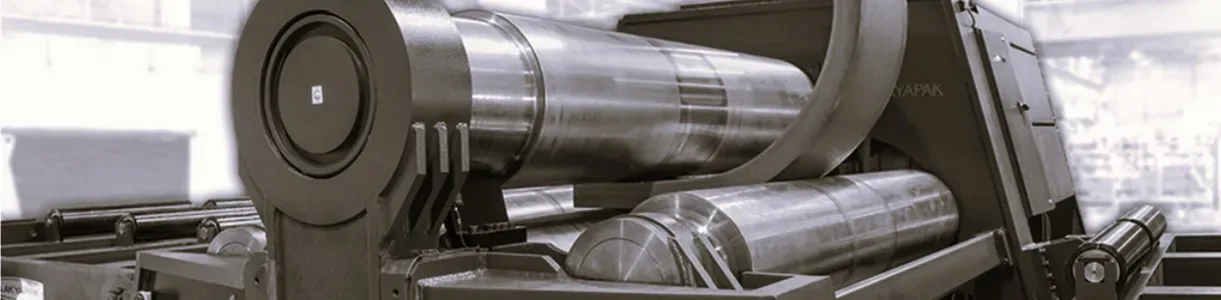
The number of rolls defines how the machine grips and bends the plate. The 4-roll system clamps the plate firmly and pre-bends both ends without removing the part, which makes it the standard for series production, precision and pressure vessels. The 3-roll is a simpler, more economical solution for work where the flat edge and repeatability are not critical. Which one suits each case is developed in the corresponding FAQ.
CONCLUSION
The machine is chosen for the part, not the other way around
Specifying a plate rolling machine is, in essence, describing well the most demanding part you will produce: its material, its thickness, its width and its diameter. With those four variables defined for the real case —not for the average— the right machine almost chooses itself, and you avoid both overbuying and falling short. As the representative of AKYAPAK plate rolls, CYM Materiales supports that definition so the equipment matches the work, and not the other way around.
Published: July 2026
KEEP EXPLORING
Related equipment and content
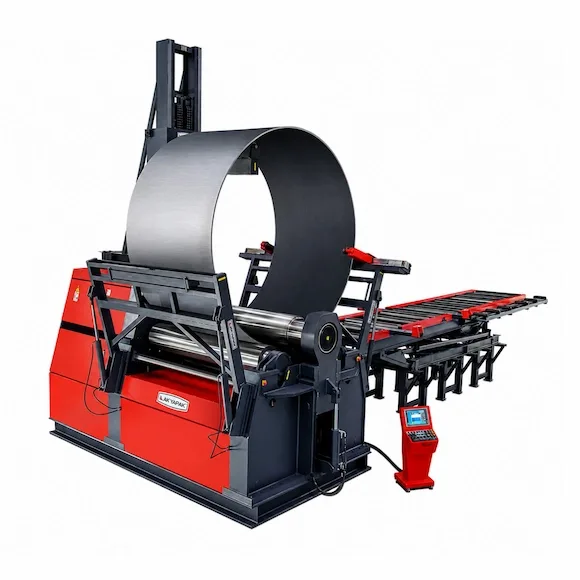
3-Roll and 4-Roll
CNC plate rolling machine
For bending shells, cylinders and cones in steel, 2 to 200 mm thick. Three-roll and four-roll versions with prebending.
Read more
FAQ
3-roll or 4-roll plate rolling machine?
Pre-bending, precision and repeatability: what each configuration gains and gives up
Read more.webp?dpl=dpl_EpfssZki41Hq8BMdPV7ygP5Yzj9T)
FAQ
What is roll crown radius in a plate bending machine?
How it compensates for roll deflection under load
Read moreInstallations
Equipment in operation
Special Projects
Can't find the equipment you need?

CYM Materiales develops it.
Our Engineering and Sales team works alongside the client to design a custom solution, reducing operating costs and maximizing productivity. Every project starts with a detailed technical assessment and ends with a machine built and tested at our plant
REQUEST A CUSTOM PROJECT