
Technical article
Shot blasting natural stone and concrete for texture
TEXTURE AND FINISH
Anti-slip and aged finish in a single pass -
Blasting is not always about cleaning
In the metalworking industry shot blasting removes rust, mill scale or foundry sand. On natural stone and concrete the goal is different: blasting does not remove a contaminant, it creates a texture. Controlled abrasive projection onto a marble, granite or concrete slab modifies the surface uniformly and repeatably, producing two results the market values separately: higher slip resistance and a matte, aged-looking finish.
Anti-slip: micro-roughness that increases friction
Abrasive impact creates a micro-roughness of tens of microns that raises the surface friction coefficient. The piece gains grip without losing its identity: colour, veining and thickness remain intact. That is why shot blasting is the usual treatment for public flooring, platforms, stairs, pool edges and outdoor walkways, where the safety standard demands a minimum slip resistance value and the project cannot change the material.
Aged finish: softening the gloss and evening out appearance
The same process at lower intensity produces a highly sought-after aesthetic finish. The polished surface loses its gloss and takes on a satin, antique-looking texture. Shot blasting also lightens the stone slightly and softens the contrast of the veins, which evens out pieces that naturally vary from one another. On facade panels, claddings and designer flooring, that consistency between pieces is as valuable as the texture itself.
Compared with flaming: no flame, no cracking, repeatable
The traditional alternative for texturing stone is flaming, which applies a high-temperature flame so that thermal shock spalls the surface. It is effective but has known limitations: it requires handling gas torches, introduces thermal stress into the material and delivers results that vary from piece to piece. Shot blasting achieves the effect mechanically, with no heat, no risk of thermal cracking and a result that repeats piece after piece because it depends on adjustable parameters: abrasive flow, belt speed and blast wheel power.
Which materials it takes?
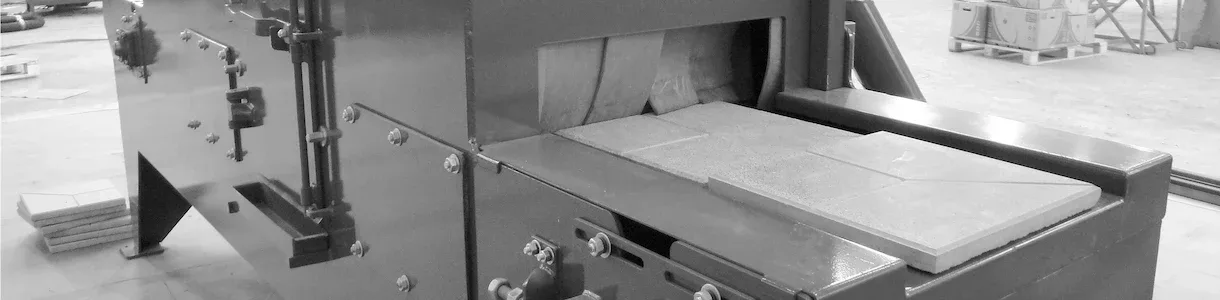
Marble, granite, travertine and natural stone in general; concrete and precast elements; tiles, pavers, kerbstones and facade panels. The condition is that the piece be flat and rest stably on the conveyor belt. Intensity is adjusted to the hardness of the material: a soft stone needs less energy than granite to reach the same texture.
Why a rubber belt and top blast wheels?
The CIN line from CYM Materiales uses a rubber conveyor belt and one or two blast wheels above the piece, which allows blasting one face only while the lower face stays intact and protected from abrasion. That is exactly what this process needs: texture is applied to the visible face, while the seating face keeps its original surface for bonding or laying. Pieces are loaded at the inlet, travel through in continuous pass and come out treated at the other end, with no intermediate handling.
Published: July 2026
KEEP EXPLORING
Related equipment and content
FAQ
What is shot blasting?
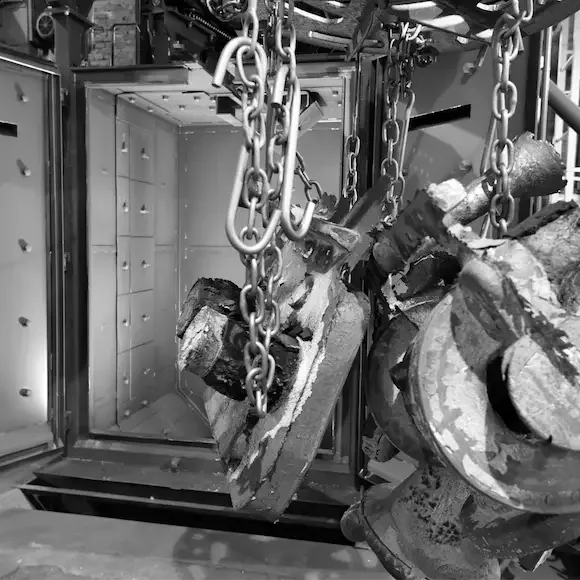
Industrial shot blasting — process, applications and equipment
Read more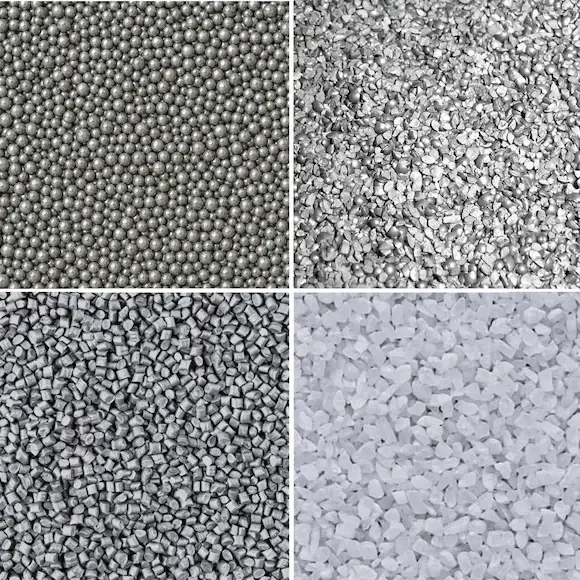
FAQ
How to choose the best blasting abrasive
Which abrasive to use by material and process
Read more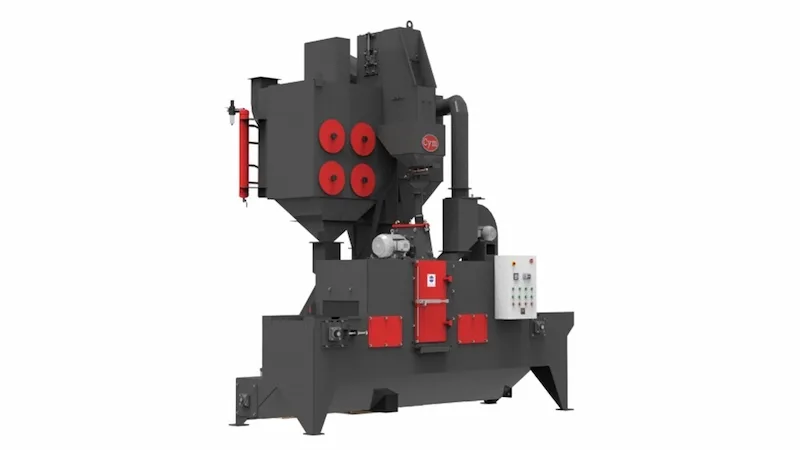
products
Continuous belt shot blast machine, rubber or mesh
Uniform texture and cleaning in automatic passage
Read moreInstallations
Equipment in operation
Videos
Equipment in action
Special Projects
Can't find the equipment you need?
CYM Materiales develops it.
Our Engineering and Sales team works alongside the client to design a custom solution, reducing operating costs and maximizing productivity. Every project starts with a detailed technical assessment and ends with a machine built and tested at our plant
REQUEST A CUSTOM PROJECT