
Technical article
Scaffold Clamps: Blasting, Safety and Inspection
RENTAL FLEET · INSPECTION · SAFETY
Why rust on scaffold clamps is not just a presentation problem
In the scaffolding rental business, clamps are the most numerous component, the one with the highest turnover and the one that generates the most reconditioning work between rentals. They return from site in large volumes, covered in rust, concrete and embedded dirt. Bulk blast cleaning resolves that challenge in a single cycle: it cleans every part of the piece — including joints, sockets and hard-to-reach areas — without individual positioning and without acids. But the most important benefit is not the presentation: it is that a clean clamp is a clamp that can be inspected.
What the rust hides
A rusty clamp is not simply an accessory that looks bad. Rust covers the metal surface and hides what lies beneath: fatigue cracks, wear on joints, bolt deformation and loss of thickness in the jaws. None of these conditions can be detected by visual inspection of a dirty part.
Safety regulations on construction sites require visual inspection of scaffolding elements before every reuse. That inspection is only effective on clean metal. A rental company that blast cleans its stock before technical inspection not only meets the regulation — it has real information on the condition of each piece and can make informed decisions about what to repair, what to discard and what to return to available stock.
The saving is twofold: premature disposal of parts that appear in poor condition but are actually serviceable is avoided, and those that genuinely need to be withdrawn from circulation are identified in time before reaching a worksite.
Why clamps require different equipment from tubes
Scaffolding tubes and uprights have simple, uniform geometry: they pass continuously through the blast machine and abrasive reaches all their faces. A clamp has completely different geometry: joints, bolts, overlapping jaws, sockets and interior zones with no linear access. A continuous-pass system cannot cover all those surfaces in a single pass.
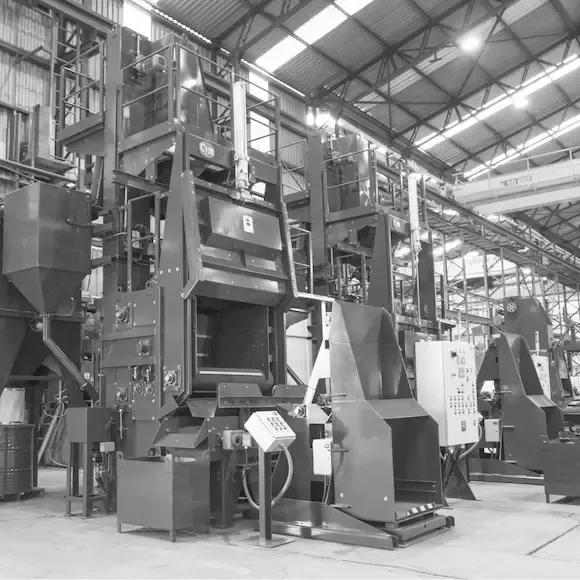
The solution for scaffold clamps and accessories is the tumblast machine (LT line). Parts are not positioned — they are bulk-loaded onto the belt. Continuous tumbling keeps the batch rotating while the blast wheels project abrasive, so every face of every part is exposed to impact without individual handling between cycles. The result is uniform across the entire clamp geometry, including interior zones and joints.
Tumbling is controlled to clean without deforming: belt speed, blast wheel intensity and cycle time are configured to preserve part geometry. A clamp does not emerge bent or weakened from the process — it emerges clean.
BEFORE
The batch as it returns from site
One hundred scaffold clamps bulk-loaded onto the belt, exactly as they came back from site: even rust across the whole part, concrete stuck to the jaws and in the joints. On a surface like this, visual inspection cannot detect a fatigue crack.
AFTER
The same batch, five minutes later
The same batch at the end of the cycle, tumbling inside the tumblast machine. The metal came out clean across the entire geometry — joints, sockets and interior zones included — and the part is ready to inspect and repaint. This is a process test on a 150 kg load; final cycle time is defined by the type and volume of part at each customer.
The complete batch flow: from site to stock ready to rent
• Receiving and sorting: clamps returning from site are sorted by type and size. No manual pre-cleaning is needed before entering the process.
• Bulk loading: the complete batch is loaded directly onto the rotary belt, without positioning part by part. Cycle capacity ranges from 20 to 600 litres depending on the model.
• Continuous blasting: blast wheels project abrasive while the belt tumbles the batch. In a single cycle, all faces of all parts receive abrasive impact.
• Discharge and inspection: parts emerge clean and uniform. With the surface free of rust, visual inspection is effective: cracks, deformations and wear are clearly visible.
• Painting and return to stock: approved parts receive paint and return to available inventory. Parts that fail inspection are withdrawn with precise information on their actual condition.
Two machines for a complete rental operation: tumblast plus continuous pass
A scaffolding rental company has two types of assets with different reconditioning requirements: bulk accessories (clamps, couplers, base plates, connectors) and structural elements with simple geometry (tubes, uprights, diagonals, boards).
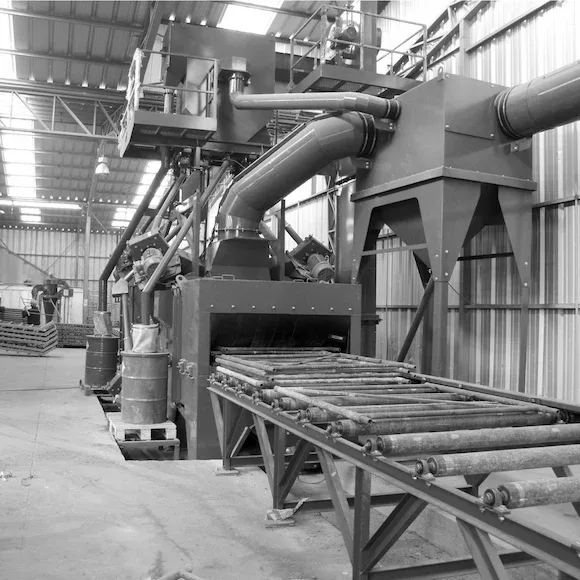
The tumblast machine (LT line) addresses the first group: it processes the batch in bulk, without positioning, with uniform coverage on complex geometries. The continuous-pass machine with inclined blast wheels (PER-I line) addresses the second: tubes and profiles pass in a continuous line with multi-directional impact reaching the entire outer surface with no shadow zones.
Together, the two machines cover the complete fleet recovery cycle — from the smallest accessory to the longest tube — with an automatic process, no acids, no liquid effluents and low operating cost per unit processed.
Published: September 2026
Keep Exploring
Related equipment and content
Technical article
Tubular scaffold shot blasting
From the job site back to rental-ready stock
Read more
TECHNICAL ARTICLE
Corrosion in steel and the role of shot blasting
How surface preparation extends the service life of steel
Read more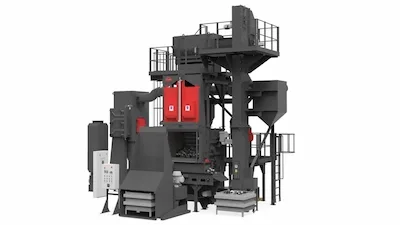
LT & LT-TAM LINE
Tumblast belt shot blast
Bulk parts: forgings, castings, auto parts. 1 or 2 blast wheels
Read moreInstallations
Equipment in operation
videos
Equipment in action
Special Projects
Can't find the equipment you need?
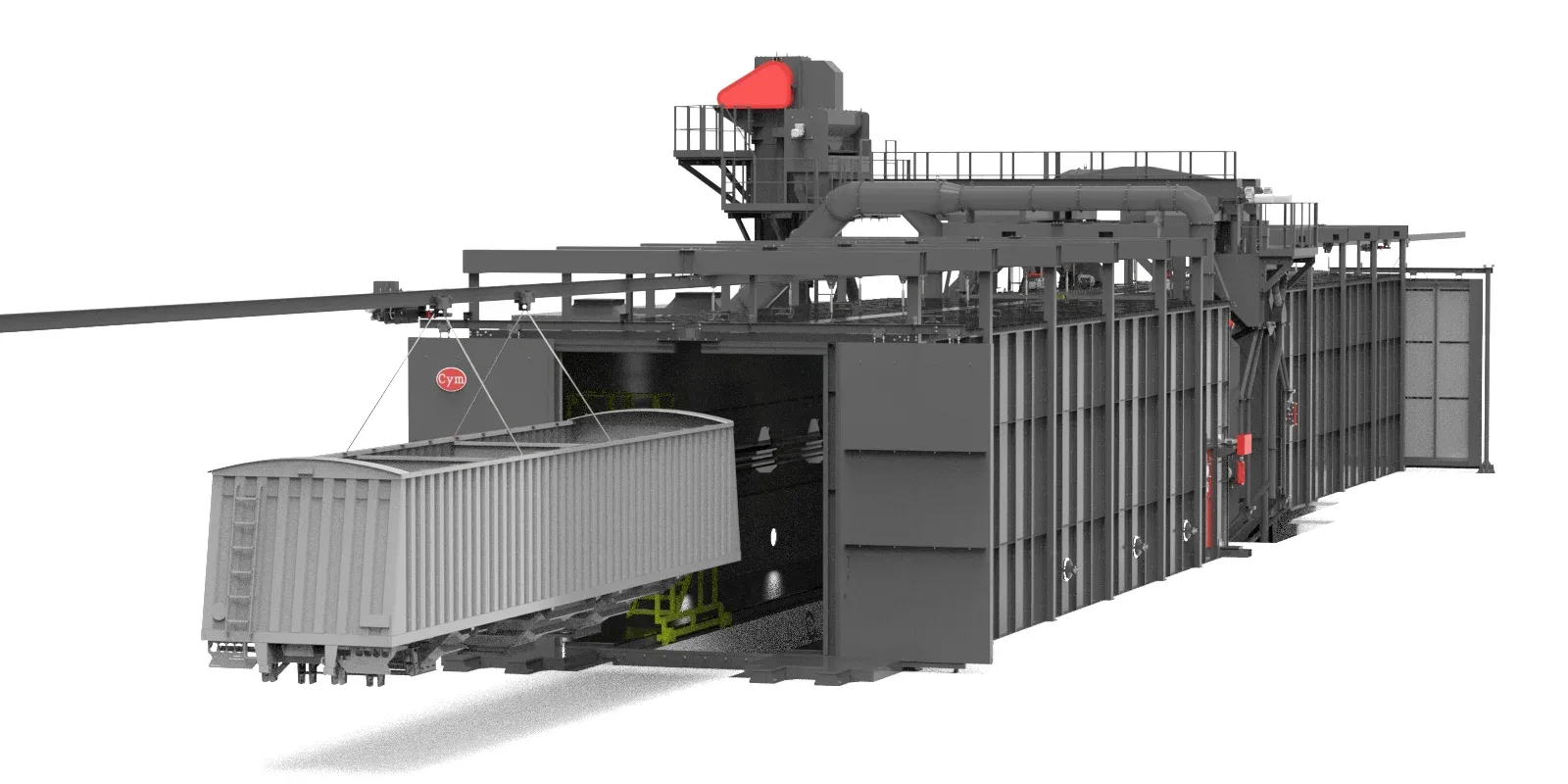
CYM Materiales develops it.
Our Engineering and Sales team works alongside the client to design a custom solution, reducing operating costs and maximizing productivity. Every project starts with a detailed technical assessment and ends with a machine built and tested at our plant
REQUEST A CUSTOM PROJECT