
TECHNICAL ARTICLES
Casting, welding or machining?
STEEL CASTING · MANUFACTURING ROUTE
How part volume, geometry and cost decide the choice
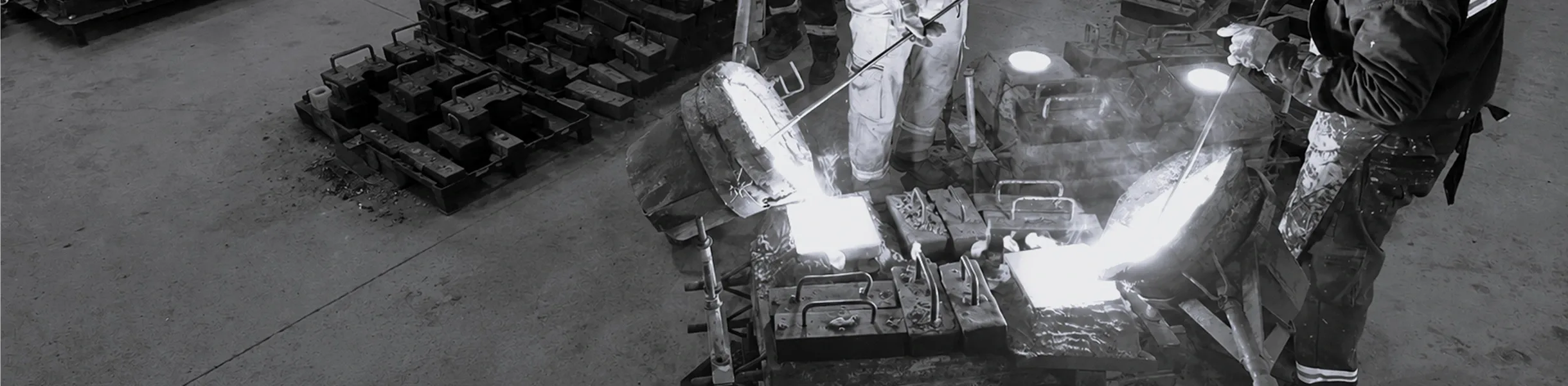
The same steel part can be manufactured by three different routes: cast, built up as a welded assembly, or machined from a solid block. None is better in absolute terms. The right route depends on the part's geometry, the quantity to be produced, how well the material is used, and the mechanical demands in service. Choosing the wrong route makes the part more expensive or shortens its service life. This guide explains the criteria that define when casting is worthwhile and when it is not.
1. The three routes to make the same part
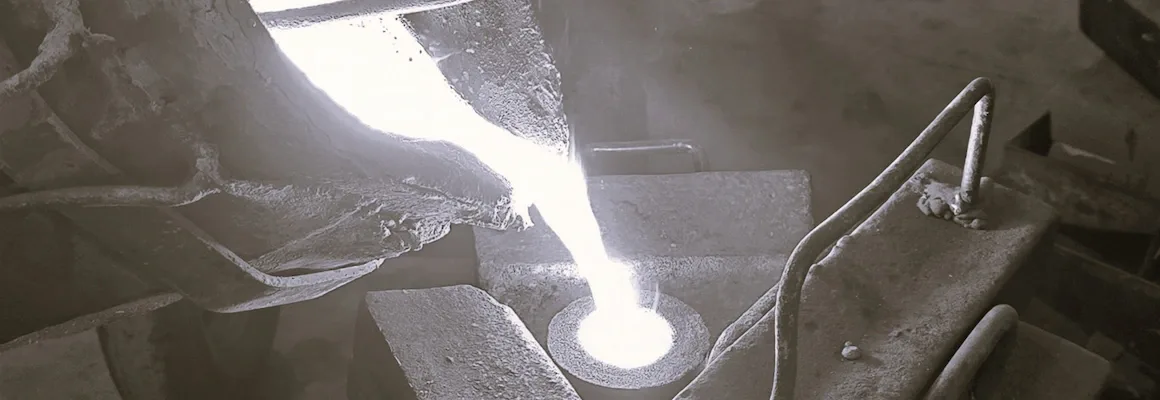
Casting pours molten steel into a mold shaped like the part: it reaches near-final shape in a single step but requires building a pattern. Welding builds the part by joining plates, profiles, or simpler components. Machining from solid removes material from a solid block until the desired shape remains. The cost difference is structural: casting carries an initial fixed cost —the pattern— that is then spread across every part, while welding and machining have little fixed cost but a higher per-part cost in labor and material.
2. Geometry: when shape decides the route
The part's shape is usually the first filter. Complex geometries —internal cavities, variable wall thickness, closed curved forms— favor casting, because molten metal fills the mold without the constraints of material removal or the joining of parts. Simple prismatic shapes with flat faces are easily machined from a block. Sheet-and-profile structures, on the other hand, are the natural ground for welding. The harder it is to obtain the shape by removing material or joining parts, the more casting is favored.
3. Part quantity: the pattern and the break-even point
The cost of the pattern is what makes quantity decisive. For a single part or a few units, that fixed cost is not amortized and machining or welding is usually preferable. As volume grows, the pattern is spread across more parts and the unit cost of casting drops below that of the other routes. That crossover —the break-even point— depends on the size of the part and on how much machining or assembly the alternatives require: the more labor-intensive it is to weld or machine each unit, the sooner casting becomes worthwhile.
4. Material usage: near-final shape vs. stock removal
Casting reaches near-final shape: practically only the metal that remains in the part is used. Machining from solid starts from a block that must contain the entire part and discards as chips all the surplus material, which in complex shapes can exceed what remains. That difference is minor in common steels but becomes decisive in expensive alloys —stainless, alloy, or heat-resistant grades— where wasted material weighs heavily on the final cost. The more expensive the alloy and the more material that must be removed, the more casting near-final shape pays off.
5. Structural integrity and fatigue
How the part is made changes its behavior under load. A cast part is monolithic: with no joints and with generous radii that distribute stresses, it avoids the weak points typical of a welded assembly. In welding, the heat-affected zone and the stress concentrations at the weld beads are where fatigue failure tends to start when the part works under cyclic loads. For parts subject to fatigue, consolidating the geometry into a single casting therefore usually gives a longer service life than an equivalent welded build. The exception is parts under maximum unidirectional loading, where forging or machining from solid keeps an edge thanks to the orientation of the material's grain flow.
6. Consolidating a welded assembly into a single casting
Many assemblies that are currently built by welding several parts can be redesigned as a single casting. The gain is manifold: weld beads are eliminated —and with them inspection points and potential failure points—, weight is reduced by matching the material to what is strictly necessary, and assembly and fit-up time is eliminated. The result is usually a lighter, more reliable, and —at volume— more economical part. This redesign is one of the clearest opportunities to cut cost and failure at the same time, and it is part of the analysis that the CYM Materiales technical team performs on every requirement.
CONCLUSION
Every part has its route
Casting is worthwhile when geometry is complex, volume amortizes the pattern, the alloy is expensive, or the part works under fatigue. Welding is the route for sheet-and-profile structures and very short runs. Machining from solid wins on simple parts, few units, or when the orientation of the material's grain flow is critical. CYM Materiales covers the complete process —from part analysis and pattern design to the cast, machined, and finished part—, with composition, hardness, and per-heat testing under ISO 9001:2015, for parts from 0.1 to 150 kg.
Special Projects
Do you need a custom part that's not in our catalog?
CYM Materials will develop it for you.
Our technical team analyzes each requirement and develops the most suitable solution: from alloy selection and model design to the finished part, ready for installation. Contact us for a free consultation.
REQUEST ADVICEPublished: July 2026