
product
Glass beads
MS LINE · SOFT IMPACT
Inert synthetic abrasive for cleaning, decorative finish and peening without metal removal
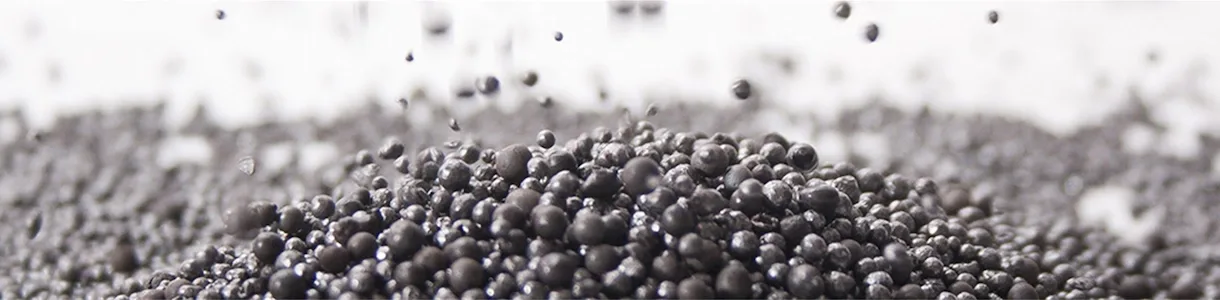
CYM Materiales supplies glass beads, a spherical synthetic abrasive made of high-purity soda-lime glass, available in four grades from MS-MLL (53–105 µm, fine) to MS-XPX (150–850 µm, super coarse). It is the reference abrasive for cleaning, decorative finishing and light peening on parts where preserving original dimensions, avoiding ferrous contamination and obtaining a uniform, repeatable surface finish are required.
Unlike mineral and metallic abrasives that work by cutting or aggressive impact, glass beads work by pure impact: they strike the surface without removing base metal, without generating anchor profile and without dragging coatings. Their spherical geometry and chemically inert composition —soda-lime glass with 70–73 % silica— allow treatment of sensitive materials such as stainless steel, aluminium, bronze, brass, copper, acrylic, plastics, glass and rubber without altering dimensions, contaminating or reacting with the treated part.
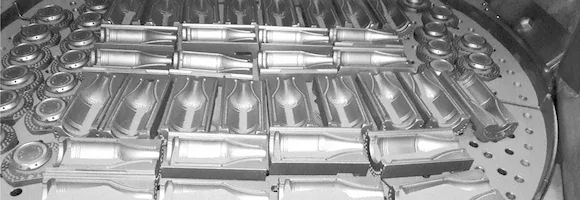
Glass beads are used in cleaning of dies and molds for casting, injection and vulcanizing; removal of carbon deposits on engine components; cleaning of rotors, armatures and brushes in electric motors; decontamination of radioactive elements in nuclear plants; precision microdeburring; decorative matte or satin matte finish on stainless, aluminium and non-ferrous parts; preparation prior to anodizing, chrome plating and galvanic coatings; engraving with masks; controlled roughness on rolls and shafts; and light peening to increase fatigue resistance on components that do not require structural Almen intensity.
If your application requires a specific recommendation, our technical team advises on the most suitable MS grade according to the part, the desired finish and the available equipment.
APPLICATIONS
Uses and processes with glass beads
Glass beads are used exclusively in compressed air systems —manual blast rooms, blast cabinets and suction or pressure rooms—, where the operator controls angle, distance and flow through the nozzle to modify the surface without altering original dimensions or contaminating the substrate. Due to their low density and limited recyclability (5–8 impacts per particle), they are not used in centrifugal wheel equipment: centrifugal force would fragment the particle before useful impact. The choice of MS grade depends on the desired finish, the type of application and the part geometry.

DECORATIVE FINISH AND SURFACE TREATMENT
- Grades MS-MLL and MS-MH (53–212 µm) for matte or satin matte finish on stainless steel, aluminium, bronze, brass, copper and plastics
- Anti-reflective finish on surgical instruments, tools, electronic equipment fronts and wipers
- Decorative engraving with masks: high definition and prolonged mask life due to minimal abrasion
- Preparation prior to anodizing, silver plating, chrome plating and other galvanic treatments without altering dimensions
- Controlled microscopic graining for lubricant and release agent retention
- Finish repeatability across batches just by maintaining operating parameters
CLEANING, MICRODEBURRING AND MAINTENANCE
- Grades MS-MH and MS-XPX (105–850 µm) for productive cleaning of dies and molds
- Cleaning of extrusion, forging and stamping dies, and molds for casting, injection and vulcanizing in aluminium, bronze, rubber, plastics, glass and zamak
- Cleaning of electric motors (rotors, armatures, brushes) and removal of carbon deposits on combustion engines
- Precision microdeburring and removal of scratches, defects and tool marks on molds and dies
- Controlled and homogeneous roughness on rolls, shafts and components with strict dimensional tolerance
- Decontamination of radioactive elements in nuclear plants and cleaning of contaminated parts in print shops
TECHNICAL SPECIFICATIONS
Manufacturing process and composition
Glass beads are manufactured as high-purity spherical soda-lime glass through a controlled process combining melting, atomization and granulometric classification to obtain chemically inert, dimensionally uniform particles. The chemical composition follows the standard for industrial soda-lime glass, with high silica content and low impurity content that could react with the treated substrate:
| Compound | Content |
|---|---|
| Silica (SiO₂) | 70 – 73 % |
| Calcium oxide (CaO) | 7 – 11 % |
| Magnesium oxide (MgO) | 3 – 5 % |
| Sodium oxide (Na₂O) | 13 – 15 % |
| Potassium oxide (K₂O) | 0,2 – 0,6 % |
High-purity industrial soda-lime glass, chemically inert with respect to commonly treated materials (steel, stainless, aluminium, bronze, brass, copper, plastics, glass, rubber, zamak). It contains no free iron oxides or heavy elements that could contaminate the substrate, allowing use in applications where surface purity is a requirement (pharmaceutical industry, food industry, surgical instruments, nuclear decontamination). The composition remains constant across the four granulometric grades of the MS line; what varies between grades is particle size, not chemistry.
Structure and physical properties
Glass beads have an amorphous structure characteristic of industrial soda-lime glass, with no crystalline order, which gives them isotropic behavior under impact and the characteristic brittle fracture upon reaching the recyclability limit. The spherical form is obtained during the atomization process of the molten glass and is subsequently controlled by optical and mechanical classification to ensure granulometric and sphericity uniformity within each grade. The physical properties relevant for selection and operation are the following:
| Property | Value | Standard or method |
|---|---|---|
| Sphericity | ≥ 70 % | ASTM D1155 (Roundometer) |
| Sphericity | ≥ 80 % | Microscopic inspection |
| Hardness | 5 – 6 | Mohs scale |
| Specific gravity | ~ 2,5 g/cm³ | — |
| Apparent density | 1,5 – 1,6 g/cm³ | Depending on grain size |
| Color | Transparent | — |
| Recyclability | 5 – 8 impacts per particle | Industrial average |
| Standard packaging | 25 kg bags | — |
Glass beads are notably lighter than any metallic shot (specific gravity ~2.5 g/cm³ vs ~4.5 for stainless and ~7.4 for carbon steel), which significantly reduces impact energy on the part and allows operation on delicate substrates without marking or deforming. Their Mohs hardness 5-6 is lower than that of most treated metals, which explains why glass beads do not remove base metal and only detach adhered contaminants. The recyclability limit of 5-8 impacts per particle is the direct consequence of glass brittleness: upon reaching the limit, particles fracture and must be separated from the operating mix by granulometric classification.
Granulometry — grades MS-MLL to MS-XPX
Glass beads are classified in four standard grades according to particle size range expressed in microns (µm), under a proper nomenclature with MS (microsphere) prefix and commercial designations recognized in the industry. Unlike metallic shot —classified by nominal passing sieve— glass beads are classified by granulometric range of minimum and maximum particle size, since the atomization process of molten glass produces broader distributions than mechanical cutting or controlled casting of metallic shot. CYM Materiales supplies the full range from MS-MLL (fine, 53–105 µm) to MS-XPX (super coarse, 150–850 µm):
| Code MS | Size (µm) | Commercial designation | Characteristic application |
|---|---|---|---|
| MS-MLL | 53 – 105 | ML — Fine | Fine satin matte finish, microdeburring, instruments |
| MS-MH | 105 – 212 | MH — Medium | Decorative matte finish, motor cleaning, pre-galvanic |
| MS-XHX | 75 – 850 | 80/2 — Coarse | Broad industrial range, productive cleaning |
| MS-XPX | 150 – 850 | 85 — Super coarse | Die cleaning, large molds, deep graining |
Classification by granulometric range in microns (µm), in accordance with the standard commercial nomenclature for glass beads for blasting. The designations “ML”, “MH”, “80/2” and “85” are the historical commercial identifications equivalent to grades MS-MLL, MS-MH, MS-XHX and MS-XPX respectively. Grades MS-XHX (75–850 µm) and MS-XPX (150–850 µm) have broader size distributions than MS-MLL and MS-MH, making them suitable for productive cleaning where finish uniformity is not critical; grades MS-MLL and MS-MH offer narrower distribution and are recommended for decorative finishing and precision applications. Granulometric ranges may have tolerances proper to the manufacturing process; special sizes outside the standard line are available on request.
GLASS BEAD SELECTION BY APPLICATION
Which application do you need to perform?
Select the application to see the recommended MS grade.
The table shows the most commonly used MS grade for each application, according to industrial practice. It is not a prescriptive rule: most applications accept more than one valid grade, and the final selection depends on the desired finish fineness, the substrate hardness and geometry, and the available equipment. For applications requiring contractual specifications (pharmaceutical, food, surgical instruments or nuclear decontamination industries) consult our technical team for a specific recommendation.
| Application | MS-MLL (53–105 µm) | MS-MH (105–212 µm) | MS-XHX (75–850 µm) | MS-XPX (150–850 µm) |
|---|---|---|---|---|
| Fine satin matte finish on stainless, aluminium and alloys | ✓ | ✓ | ||
| Decorative matte finish with sheen on large parts | ✓ | ✓ | ||
| Precision microdeburring without dimensional change | ✓ | |||
| Cleaning of surgical instruments and anti-reflective finish | ✓ | |||
| Decorative engraving with masks | ✓ | ✓ | ||
| Preparation prior to anodizing, silver plating and chrome plating | ✓ | ✓ | ||
| Cleaning of electric motors (rotors, armatures, brushes) | ✓ | ✓ | ||
| Removal of carbon deposits on combustion engines | ✓ | ✓ | ||
| Cleaning of extrusion, forging and stamping dies | ✓ | ✓ | ✓ | |
| Cleaning of casting, injection and vulcanizing molds | ✓ | ✓ | ✓ | |
| Controlled roughness on rolls and shafts | ✓ | ✓ | ||
| Decontamination of radioactive elements | ✓ | ✓ | ||
| Productive series cleaning with lower finish demand | ✓ | ✓ |
RESOURCES AND RELATED LINKS
Technical data sheet, alternative abrasives and technical articles
FAQ
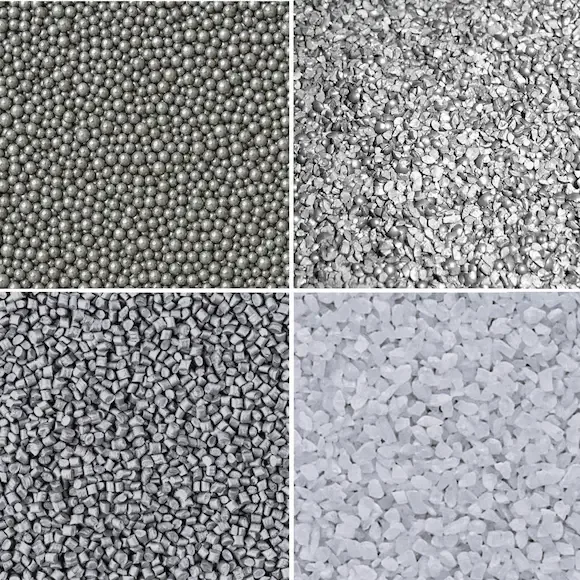
How to choose the best blasting abrasive
Which abrasive to use by material and process
Read more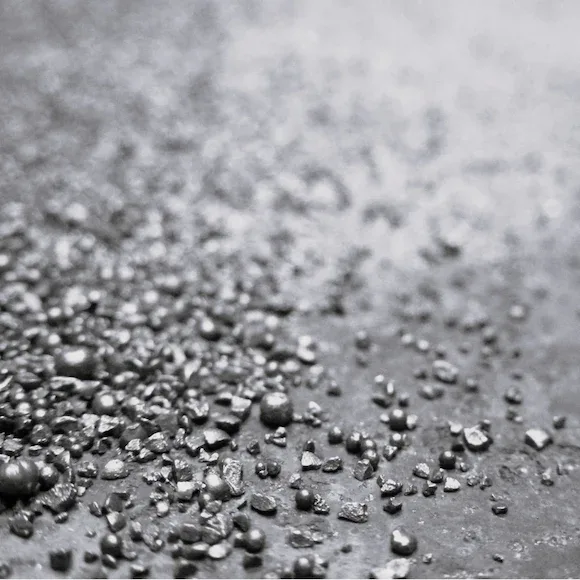
FAQ
What is shot blasting abrasive?
Shot blasting abrasive — the material that defines process quality
Read more
FAQ
Why replace sand with metallic shot?
Metallic shot vs sand — operational and economic advantages
Read moreABRASIVE SELECTION
Not sure which abrasive your process needs?
CYM Materiales helps you define it
Our technical team reviews the part material, the available equipment, the finish you are after and the applicable standard, and recommends the right type, size and hardness. Get in touch, with no obligation.
REQUEST ADVICE