
products
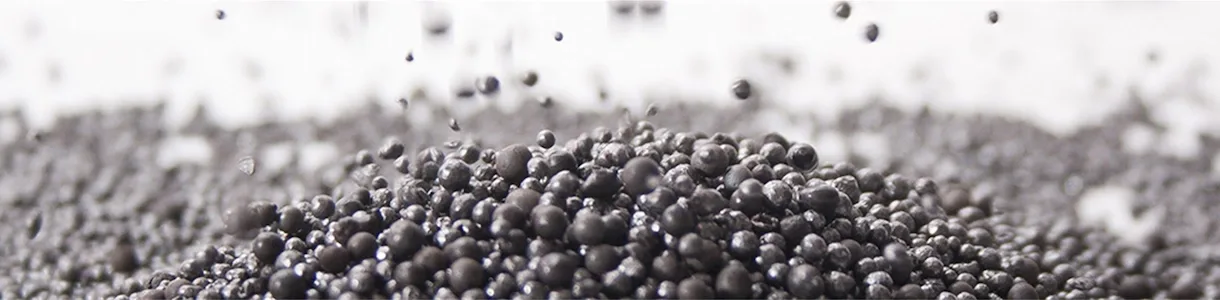
Carbon steel angular grit
SAE J-444 LINE · GRIT
Metallic abrasive for high anchor profile and surface preparation
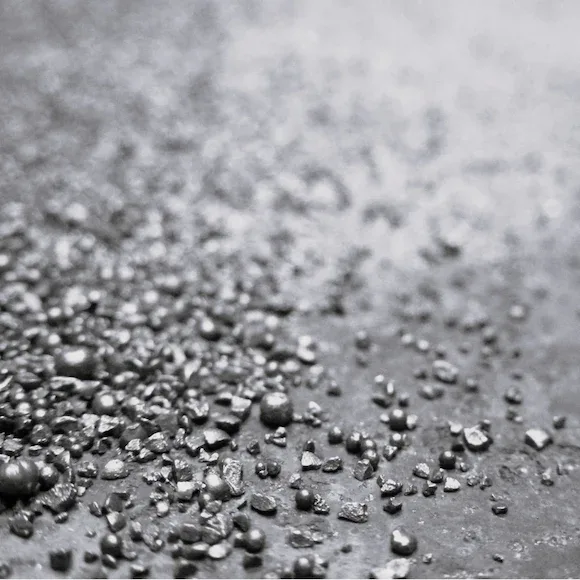
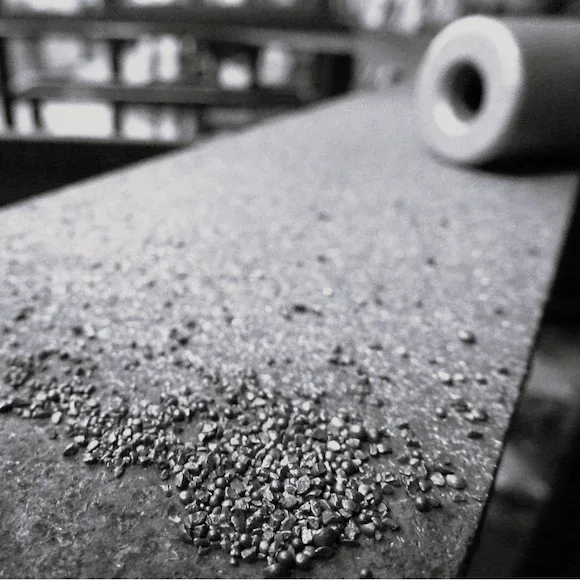
CYM Materiales supplies carbon steel angular grit under SAE J-444, SAE J-827 and SAE J-1993 standards, in nine grades from G12 to G120 and in three standard hardness levels C, D and H. It is the reference metallic abrasive for surface preparation requiring a high anchor profile, thanks to its sharp edges that deliver aggressive cutting action and uniform roughness on the substrate.
Angular grit is produced from hardened spherical shot through a controlled crushing process, yielding particles with angular geometry and sharp edges. It retains the fine, homogeneous tempered martensitic structure of carbon steel, a necessary condition to withstand impact cycles while maintaining cutting capacity throughout the media life.
Angular grit is used for surface preparation prior to paint, metallizing and coatings, mill scale descaling on forged parts and rolled products, blasting of rolling mill cylinders, cleaning of steel structures and casting deburring. It is recyclable —though for fewer cycles than spherical shot— and is selected by grade and hardness according to the equipment, the material being treated and the required roughness.
If your application requires a specific recommendation, our technical team advises on the most suitable SAE grade and hardness.
APPLICATIONS
Uses and processes with angular grit
Carbon steel angular grit is the reference metallic abrasive when a high anchor profile and aggressive cutting on the substrate are required. Its sharp edges generate uniform, deep roughness, a necessary condition for paint, coating and metallizing adhesion. It is used both in centrifugal wheel machines and in compressed air systems, and the choice of SAE grade and hardness depends on the equipment, the material to be treated and the required roughness.
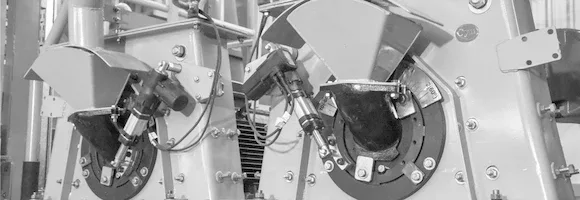
CENTRIFUGAL WHEEL BLASTING
- Compatible with CYM Materiales wheel equipment for surface preparation of structures, plates and profiles
- Recommended for blasting thin plates: its edges work by cutting and do not induce compressive stresses, avoiding the deformation that spherical shot would produce
- Especially indicated for blasting plates in vertical pass equipment, due to its high roughness and excellent anchor profile
- Grades G12 to G50 according to part volume and required roughness
- Hardness C or D for aggressive cutting and fast mill scale removal
- Hardness H for surface preparation with uniformly angular, sustained roughness
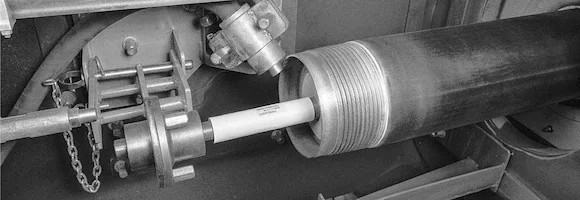
AIR BLASTING
- Suited to blast rooms, blast cabinets and pressure blast pots
- Grades G25 to G120 according to required anchor profile (from medium to fine)
- Allows directional nozzle control on complex parts or localized areas
- Surface preparation prior to industrial paint per Sa 2½ and Sa 3 grades (ISO 8501-1)
- Applications: ship structures, wind towers, mining equipment, heavy civil works
- Available in hardness H to maintain edges throughout media life
TECHNICAL SPECIFICATIONS
Manufacturing standards and chemical composition
CYM Materiales angular grit is manufactured under international standards SAE J-444 (granulometry), SAE J-827 (quality and composition) and SAE J-1993 (high-carbon cast steel shot). Chemical composition is kept within the following ranges:
Manufacturing standards and chemical composition
| Element | Content |
|---|---|
| Carbon (C) | 0,80 % – 1,20 % |
| Manganese (Mn) | 0,60 % – 1,20 % |
| Silicon (Si) | > 0,40 % |
| Phosphorus (P) | ≤ 0,05 % |
| Sulfur (S) | ≤ 0,05 % |
Values comply with SAE J-827 (quality and composition of cast carbon steel shot) and SAE J-1993 (high-carbon cast steel shot). Unlike spherical shot, the minimum manganese content does not vary by grade: the standard sets a single range for the entire grit line
Metallurgical structure
Angular grit has a fine, homogeneous tempered martensitic structure obtained through a controlled tempering process. This treatment arranges iron and carbon atoms as finely and regularly as possible, delivering uniform hardness and strength across the particle set and enabling thousands of impact cycles without premature fragmentation.
Granulometry — SAE J-444 grades
Angular grit is classified in nine grades according to SAE J-444, based on nominal grain size. Each grade defines the sieve through which at least 75 % or 85 % of the material must pass, depending on the range. CYM Materiales supplies the full range from G12 (coarse grit for aggressive cutting and fast mill scale removal) to G120 (fine grit for finishes with controlled anchor profile):
| Grade | Nominal sieve (mm) | Min pass (SAE J-444 standard) |
|---|---|---|
| G12 | 2.00 | sieve 10 / 2.80 (80 %) · sieve 12 / 2.00 (90 %) |
| G14 | 1.70 | sieve 12 / 2.30 (80 %) · sieve 14 / 1.70 (90 %) |
| G16 | 1.18 | sieve 14 / 1.70 (75 %) · sieve 16 / 1.18 (85 %) |
| G18 | 1.00 | sieve 16 / 1.18 (75 %) · sieve 18 / 1.00 (85 %) |
| G25 | 0.71 | sieve 18 / 1.00 (70 %) · sieve 25 / 0.71 (80 %) |
| G40 | 0.42 | sieve 25 / 0.71 (70 %) · sieve 40 / 0.42 (80 %) |
| G50 | 0.3 | sieve 40 / 0.42 (65 %) · sieve 50 / 0.30 (75 %) |
| G80 | 0.18 | sieve 50 / 0.30 (65 %) · sieve 80 / 0.18 (75 %) |
| G120 | 0.13 | sieve 80 / 0.18 (60 %) · sieve 120 / 0.13 (70 %) |
Classification per SAE J-444. The “Min pass” column indicates the two minimum requirements of the standard for each grade: percentage of material passing the upper sieve of the range and percentage passing the nominal sieve. Unlike shot, the grit standard does not set a maximum limit on the coarse side, only minimum pass requirements. Percentages decrease progressively from 90 % in coarse grades (G12-G14) down to 70 % in fine grades (G120). Sieves in US mesh system — ISO 565 equivalence available on request. For the full SAE J-444 sieve matrix, download the technical datasheet in PDF.
Hardness
Angular grit hardness directly affects cutting speed, edge retention and media life. CYM Materiales supplies three standard hardness types according to the application: hardness C and D progressively lose angles during blasting, rounding the particles with use, and are particularly recommended for mill scale removal processes; hardness H, with the highest value, keeps particles angular in the operating mix and is the correct choice when uniformly rough surfaces are required throughout the media life:
| Designation | Vickers (HV) | Rockwell C (HRC) | Behavior in use | Application |
|---|---|---|---|---|
| C | 480 – 550 | 48 – 52 | Rounds quickly with use | Mill scale removal and surface preparation |
| D | 577 – 720 | 54 – 61 | Loses angles progressively during blasting | Mill scale removal and surface preparation |
| H | > 697 | > 60 | Keeps particles angular in the operating mix | Surface preparation with sustained uniform roughness |
Measurements taken with the Vickers method (HV) under loads of 0.5 to 1 kgf, in line with industrial practice for angular grains. Conversion to Rockwell C (HRC) follows standard ASTM E140 tables. Unlike spherical shot, the angular line does not include PE hardness: the three hardness levels C, D and H cover the full range of industrial surface preparation and descaling applications.
GRIT SELECTION BY APPLICATION
Which application do you need to perform?
The table shows the SAE grade and hardness most commonly used for each application, according to industrial practice. It is not a prescriptive rule: most applications accept more than one valid combination, and the final choice depends on the available equipment, the targeted productivity, the part hardness and the required finish. Consult our technical team for a specific recommendation.
| Application | G12–G18 | G25–G40 | G50–G80 | G120 | Hardness C/D | Hardness H |
|---|---|---|---|---|---|---|
| Mill scale removal on forged parts and rolled products | ✓ | ✓ | ✓ | |||
| Descaling of rolling mill cylinders | ✓ | ✓ | ✓ | ✓ | ✓ | |
| Blasting of thin plates in vertical pass equipment | ✓ | ✓ | ✓ | ✓ | ||
| Surface preparation prior to industrial paint | ✓ | ✓ | ✓ | ✓ | ||
| Blasting of ship structures and heavy civil works | ✓ | ✓ | ✓ | |||
| Blasting of wind towers and mining equipment | ✓ | ✓ | ✓ | ✓ | ✓ | |
| Finish with controlled, fine anchor profile | ✓ | ✓ | ✓ | ✓ | ||
| Air blasting (nozzles) | ✓ | ✓ | ✓ | ✓ | ✓ | |
| Centrifugal wheel blasting | ✓ | ✓ | ✓ | ✓ | ✓ |
RESOURCES AND RELATED LINKS
Technical data sheet, alternative abrasives and technical articles
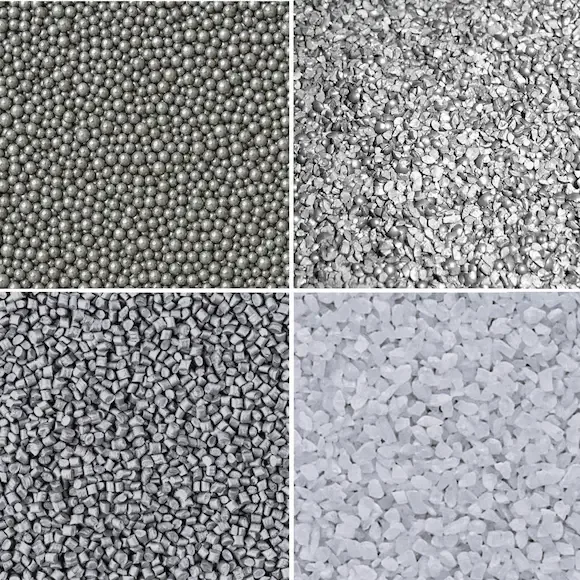
ABRASIVE SELECTION
Not sure which abrasive your process needs?
CYM Materiales helps you define it
Our technical team reviews the part material, the available equipment, the finish you are after and the applicable standard, and recommends the right type, size and hardness. Get in touch, with no obligation.
REQUEST ADVICE