
Product
Stainless steel angular grit
STAINLESS STEEL LINE · ANGULAR
Metallic abrasive with sharp edges for anchor profile without ferrous contamination
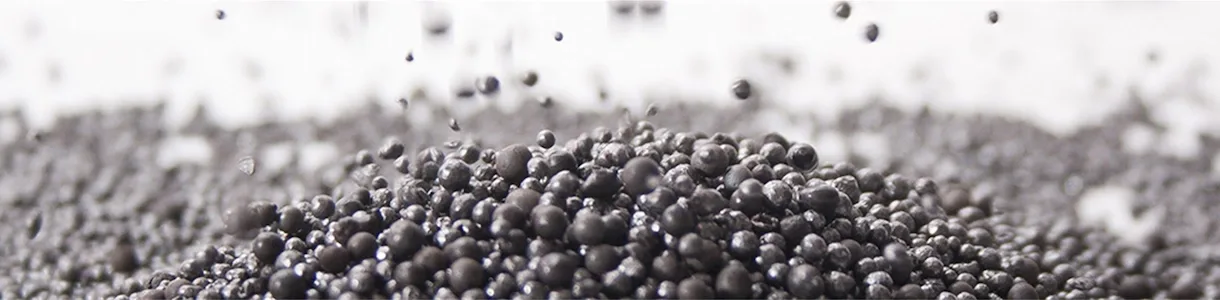
CYM Materiales supplies Grittal stainless steel angular grit, a cast metallic abrasive in hardened chromium-iron alloy, available in ten grades from G10 to G300. It is the correct technical choice for applications that simultaneously require an aggressive anchor profile and total absence of ferrous contamination: surface preparation on aluminium and stainless steel, decorative blasting of natural stone, removal of ceramics on cast parts and treatment of galvanized steels.
Unlike stainless spherical shot, angular grit works by cutting rather than impact: its sharp edges generate high roughness on the substrate, a necessary condition for the adhesion of paint, ceramic coatings, teflon, porcelain and powder coatings. The chromium-iron alloy provides corrosion resistance without nickel: the Grittal GH composition has a martensitic matrix with chromium carbides, while the Grittal GM composition has a ferritic matrix with chromium carbides, allowing selection of the most suitable hardness for each application.
Stainless angular grit is used in preparation prior to ceramic and polymeric coatings, mill scale removal on heat-treated or forged parts, finishing of aluminium and zamak castings, brushing of galvanized steels, blasting in shipyards and humid environments, and engraving and texturing of granite and prestressed concrete. It is virtually dust-free, reduces consumption by 50 % to 85 % compared with mineral abrasives, and replaces aluminium oxide, garnet and Starblast in applications where total cost per treated area is decisive.
If your application requires a specific recommendation, our technical team advises on the most suitable Grittal grade and composition — GH or GM.
APPLICATIONS
Uses and processes with stainless angular grit
Grittal stainless steel angular grit is used where simultaneously high anchor profile and absence of ferrous contamination are required, two conditions that no other metallic abrasive combines. Its sharp edges and high hardness generate uniform, deep roughness on the substrate, ideal for adhesion of paint, ceramic coatings, porcelain, teflon and powder coatings. It is used both in centrifugal wheel machines and in compressed air systems —pressure or suction— and the choice of grade and composition (Grittal GH or GM) depends on the substrate hardness, the available equipment and the required finish.
CENTRIFUGAL WHEEL BLASTING
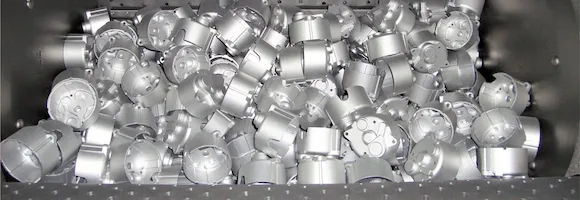
- Compatible with CYM Materiales wheel equipment for aluminium, stainless steel and non-ferrous parts where a high anchor profile is required
- Suited to mill scale removal after heat treatment, forging and foundry sand on aluminium and zamak
- Recommended for finishing of cast parts and removal of ceramic inclusions
- Grades G20 to G60 for heat treatment, casting and aggressive cutting applications
- Grittal GH composition (~800 HV) for maximum edge retention on hard substrates
- Grittal GM composition (~660 HV) for soft substrates with lower equipment wear
- No ferrous contamination: replaces aluminium oxide, garnet and Starblast in critical applications
- Higher consumption and wheel wear than with stainless spherical shot
AIR BLASTING — PRESSURE AND SUCTION
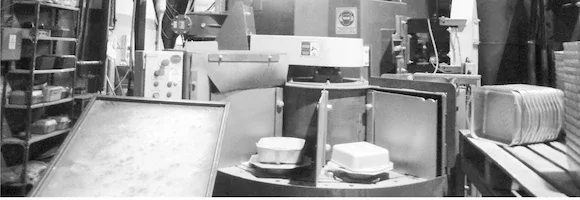
- Suited to blast cabinets, manual blast rooms and suction and pressure systems
- Fine grades G80 to G200 for preparation prior to ceramic coatings, porcelain, teflon and powder coatings
- Medium grades G20 to G50 for engraving and texturing of granite and prestressed concrete
- Recommended for fast brushing of galvanized steels (G20-G40) without removing the zinc base
- Recommended for blasting in shipyards and humid environments where carbon steel would oxidize
- 80 % Chronital S10 + 20 % Grittal G10 mix to remove blue discoloration on stainless steel welds
- Reduces abrasive consumption by 50 % to 85 % compared with single-use mineral abrasives
TECHNICAL SPECIFICATIONS
Manufacturing standard and chemical composition
Stainless steel angular grit is manufactured as cast grit in chromium-iron alloy, edged and hardened, with natural corrosion resistance. Unlike the stainless spherical line, produced in austenitic chromium-nickel steel, the angular line uses a high-carbon chromium-iron alloy whose composition allows sharp edges and fixed hardness through heat treatment of the matrix. CYM Materiales supplies two compositions differentiated by matrix structure: Grittal GH, with martensitic matrix, and Grittal GM, with ferritic matrix, both with dispersed chromium carbides:
| Elemento | Grittal GH | Grittal GM |
|---|---|---|
| Carbon (C) | 1,9 – 2,1 % | 1,9 – 2,1 % |
| Chromium (Cr) | 30 – 33 % | 30 – 33 % |
| Silicon (Si) | 0,7 – 1,0 % | 0,7 – 1,0 % |
Cast angular grit in high-carbon chromium-iron alloy, corrosion-resistant. The difference between Grittal GH and Grittal GM does not lie in chemical composition but in the metallurgical structure obtained after heat treatment: martensitic matrix with chromium carbides in Grittal GH (higher hardness, better edge retention on hard substrates) and ferritic matrix with chromium carbides in Grittal GM (lower hardness, lower equipment wear on soft substrates). Unlike carbon steel shot and stainless spherical shot, angular grit does not follow SAE J-444 or the Chronital nomenclature: it is classified by its own Grittal grades G10 to G300.
Metallurgical structure
Grittal angular grit has two distinct metallurgical structures depending on the chosen composition, both obtained through controlled heat treatment of the high-carbon chromium-iron alloy. Grittal GH offers a martensitic matrix with dispersed chromium carbides, giving the maximum hardness of the line (~800 HV / 64 HRC) and excellent edge retention throughout media life: it is the correct composition for hard substrates and applications where roughness must be uniform and sustained. Grittal GM offers a ferritic matrix with the same chromium carbides, with intermediate hardness (~660 HV / 58 HRC) that reduces wear on blast wheels and nozzles on softer substrates. Unlike stainless spherical shot, angular grit does not undergo work hardening during operation: hardness is fixed from supply and remains constant throughout media life, allowing stable process parameters and repeatable results from the first cycle.
Granulometry — Grittal grades G10 to G300
Granulometry — Grittal grades G10 to G300
Stainless angular grit is classified in ten grades by nominal grain size, in a nomenclature proper to the Grittal line with the same dimensional criterion as the spherical Chronital line (substituting the S prefix for G). Each grade defines the sieve through which at least 90 % of the material must pass and a maximum 5 % limit on the next coarser sieve. CYM Materiales supplies the full range from G10 (fine grit for finishes on ceramics, teflon and porcelain) to G300 (coarse grit for heat treatment, forging and foundry sand):
| Code | Nominal sieve (mm) | Specification |
|---|---|---|
| G300 | 2.50 | max 5 % in sieve 3.0 mm · min 90 % passes sieve 1.7 mm |
| G200 | 2.00 | max 5 % in sieve 2.0 mm · min 90 % passes sieve 1.4 mm |
| G150 | 1.40 | max 5 % in sieve 1.7 mm · min 90 % passes sieve 1.25 mm |
| G100 | 1.25 | max 5 % in sieve 1.4 mm · min 90 % passes sieve 1.0 mm |
| G60 | 1.00 | max 5 % in sieve 1.25 mm · min 90 % passes sieve 0.7 mm |
| G50 | 0.80 | max 5 % in sieve 1.0 mm · min 90 % passes sieve 0.6 mm |
| G40 | 0.60 | max 5 % in sieve 0.8 mm · min 90 % passes sieve 0.4 mm |
| G30 | 0.50 | max 5 % in sieve 0.5 mm · min 90 % passes sieve 0.14 mm |
| G20 | 0.30 | max 5 % in sieve 0.3 mm · min 90 % passes sieve 0.09 mm |
| G10 | 0.20 | max 5 % in sieve 0.2 mm · pass-through 0.09 mm |
Classification proper to the Grittal line, according to manufacturer nomenclature. Each grade of the angular Grittal line has the same granulometric band as the equivalent grade in the spherical Chronital line: G300 ≡ S300, G200 ≡ S200, and so on — only grain geometry changes (angular vs spherical). Unlike carbon steel shot, stainless angular grit does not follow SAE J-444; the approximate size equivalence with the SAE line is Grittal G300 (Cr-Fe) ≈ G12 (SAE J-444 carbon) and Grittal G10 (Cr-Fe) ≈ G120 (SAE J-444 carbon), although chemical composition and operating behavior are radically different. The “Specification” column indicates the two limits of the band: maximum on the next coarser sieve (coarse side) and minimum pass through the nominal sieve. Sieves in metric system — ISO 565 and US mesh equivalence available on request. For the full sieve matrix, download the technical datasheet in PDF.
Hardness
Grittal angular grit hardness is fixed from supply and remains constant throughout media life, unlike the spherical Chronital line which evolves through work hardening. The high-carbon chromium-iron alloy reaches hardness levels above any spherical steel shot, resulting in higher cutting aggressiveness, better edge retention and greater impact resistance. CYM Materiales supplies two hardness levels according to the hardness of the substrate to be treated:
| Composition | Vickers (HV) | Rockwell C (HRC) | Structure | Application |
|---|---|---|---|---|
| Grittal GH | ~800 | ~64 | Martensitic with chromium carbides | Hard substrates, edge retention, sustained high anchor profile |
| Grittal GM | ~600 | ~58 | Ferritic with chromium carbides | Soft substrates, lower equipment wear, brushing applications |
Measurements taken with the Vickers method (HV) under loads of 0.5 to 1 kgf, in line with industrial practice for angular grains. Conversion to Rockwell C (HRC) follows standard ASTM E140 tables. Unlike carbon steel shot (grit with three hardness levels C, D and H) and stainless spherical shot (single hardness evolving through work hardening), stainless angular grit is offered exclusively in these two fixed-hardness compositions. Media density is approximately 4.0 g/cm³, similar to stainless spherical shot (4.5 g/cm³) and notably lower than carbon steel (~7.4 g/cm³), allowing good cutting aggressiveness without generating excessive stress on the part.
GRIT SELECTION BY APPLICATION
Which application do you need to perform?
Select the application to see the recommended Grittal grade and composition.
The table shows the most commonly used Grittal grade and composition (GH or GM) for each application, according to industrial practice. It is not a prescriptive rule: most applications accept more than one valid grade, and the choice between GH and GM depends on the substrate hardness and the balance between cutting aggressiveness and equipment wear. The final selection depends on the available equipment, the part to be treated, the targeted productivity and the required finish. Consult our technical team for a specific recommendation.
| Application | G10–G30 | G40–G60 | G100–G150 | G200–G300 | Grittal GH | Grittal GM |
|---|---|---|---|---|---|---|
| Preparation prior to ceramic coatings, porcelain and teflon | ✓ | ✓ | ✓ | |||
| Preparation prior to powder coatings | ✓ | ✓ | ✓ | ✓ | ||
| Mill scale removal after heat treatment and forging | ✓ | ✓ | ✓ | ✓ | ||
| Finishing of cast parts and removal of ceramics | ✓ | ✓ | ✓ | ✓ | ✓ | |
| Fast brushing of galvanized steels | ✓ | ✓ | ✓ | ✓ | ||
| Cleaning of contaminated components (decontamination) | ✓ | ✓ | ✓ | ✓ | ||
| Surface preparation in shipyards and humid environments | ✓ | ✓ | ||||
| Engraving and texturing of granite and prestressed concrete | ✓ | ✓ | ✓ | ✓ | ✓ | |
| Air blasting (nozzles) | ✓ | ✓ | ✓ | ✓ | ||
| Centrifugal wheel blasting | ✓ | ✓ | ✓ | ✓ |
RESOURCES AND RELATED LINKS
Technical data sheet, alternative abrasives and technical articles
FAQ
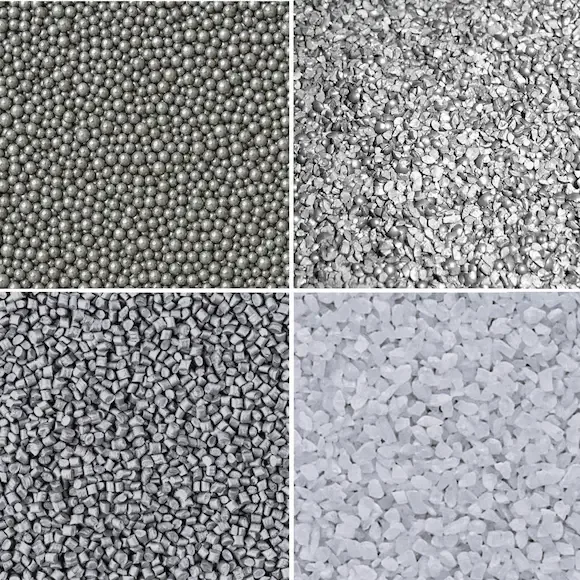
How to choose the best blasting abrasive
Which abrasive to use by material and process
Read more
FAQ
What is shot blasting abrasive?
Shot blasting abrasive — the material that defines process quality
Read more
Technical article
Steel grit vs. aluminum oxide
Which suits you by recovery, ferrous contamination and cost
Read moreABRASIVE SELECTION
Not sure which abrasive your process needs?
CYM Materiales helps you define it
Our technical team reviews the part material, the available equipment, the finish you are after and the applicable standard, and recommends the right type, size and hardness. Get in touch, with no obligation.
REQUEST ADVICE