
PRODUCTS
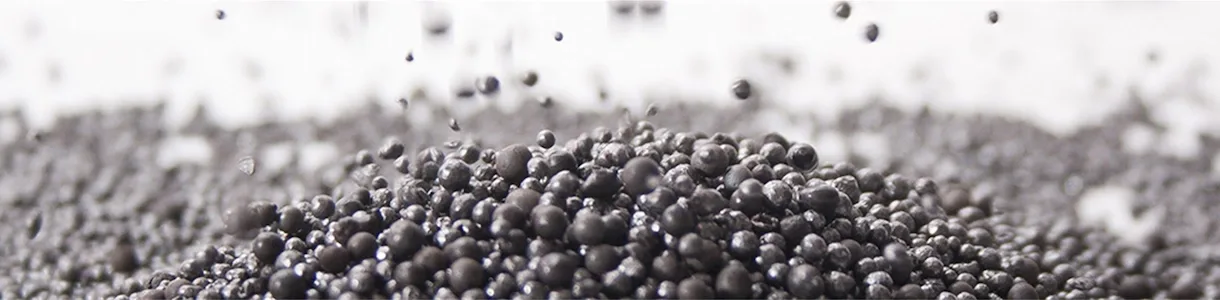
Carbon steel spherical shot
SAE J-444 line · SHOT
Metallic abrasive for centrifugal wheel blasting and air blasting
CYM Materiales supplies carbon steel spherical shot under SAE J-444, SAE J-827 and SAE J-1993 standards, in eleven grades from S70 to S780 and in standard hardness H and P. It is the most widely used abrasive in centrifugal wheel blasting and air blasting, owing to its recyclability —between 700 and 5,000 cycles depending on diameter, type and hardness— and the uniform cleaning it delivers without generating an aggressive profile.
The shot is produced from high-quality carbon steel and heat-treated to obtain a fine, homogeneous tempered martensitic structure. This controlled tempering arranges the iron and carbon atoms as finely and regularly as possible, a necessary condition to withstand thousands of impact cycles and keep hardness and strength uniform across the particle set.
Spherical shot is used in foundry sand removal, descaling of forged parts and rolled products, cleaning of steel structures, shot peening of mechanical components and surface preparation prior to paint, metallizing and coatings. It does not absorb moisture, requires no pre-drying and is selected by grade and hardness according to the equipment, the material being treated and the required finish.
If your application requires a specific recommendation, our technical team advises on the most suitable SAE grade and hardness.
APPLICATIONS
Uses and processes with spherical shot
Carbon steel spherical shot is the most versatile metallic abrasive in industrial blasting. It is used both in centrifugal wheel machines and in compressed air systems, for cleaning, descaling, surface preparation and shot peening. SAE grade and hardness are selected according to the type of equipment, the material to be treated and the required result.
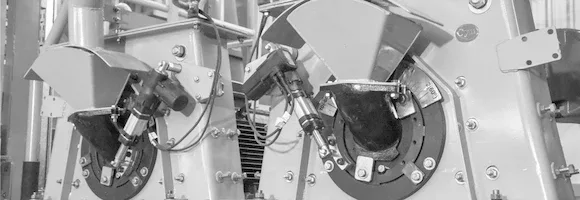
CENTRIFUGAL WHEEL BLASTING
- Compatible with the full CYM Materiales wheel line
- Recyclable between 700 and 5,000 cycles depending on diameter, type and hardness
- Uniform cleaning without generating an aggressive surface profile
- Grades S110 to S780 according to part volume and process speed
- Does not absorb moisture; no pre-drying or conditioning required
- Stable, low-dust operating mix
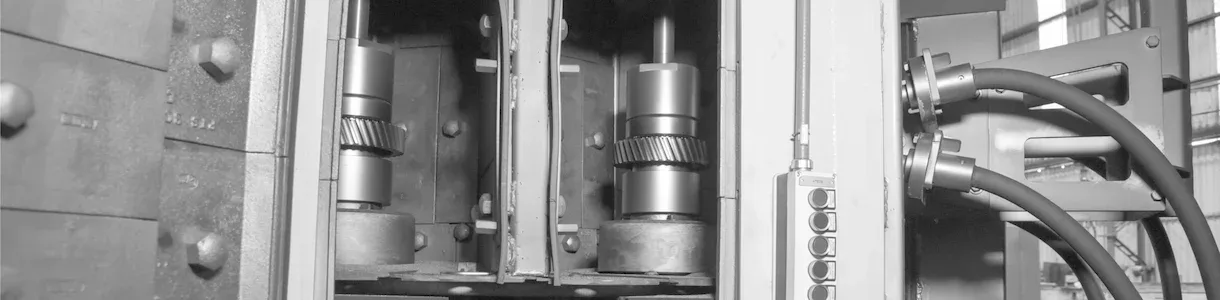
AIR BLASTING AND SHOT PEENING
- Suited to blast rooms, blast cabinets and pressure blast pots
- Fine grades S110 to S230 for low-to-medium intensity shot peening
- Allows directional nozzle control on complex or hard-to-reach parts
- Compatible with pneumatic and cyclonic recovery systems
- Applications: springs, leaf springs, gears, blades, aerospace components
- Available in hardness P for parts with high surface hardnes
TECHNICAL SPECIFICATIONS
Manufacturing standards and chemical composition
CYM Materiales spherical shot is manufactured under international standards SAE J-444 (granulometry), SAE J-827 (quality and composition) and SAE J-1993 (high-carbon cast steel shot).
Chemical composition is kept within the following ranges:
| Element | Content |
|---|---|
| Carbon (C) | 0,80 % – 1,20 % |
| Manganese (Mn) — S-110 | 0,35 % – 1,20 % |
| Manganese (Mn) — S-170 | 0,50 % – 1,20 % |
| Manganese (Mn) — ≥ S-230 | 0,60 % – 1,20 % |
| Silicon (Si) | > 0,40 % |
| Phosphorus (P) | ≤ 0,05 % |
| Sulfur (S) | ≤ 0,05 % |
Values comply with SAE J-827 (quality and composition of cast carbon steel shot) and SAE J-1993 (high-carbon cast steel shot). Manganese content varies by grade per standard requirement: fine grades allow lower minimum content.
Metallurgical structure
The shot has a fine, homogeneous tempered martensitic structure obtained through a controlled tempering process. This treatment arranges the iron and carbon atoms as finely and regularly as possible, delivering uniform hardness and strength across the particle set and enabling thousands of impact cycles without premature fragmentation.
Granulometry — SAE J-444 grades
Spherical shot is classified in eleven grades according to SAE J-444, based on nominal grain size. Each grade defines the sieve through which at least 85 % of the material must pass. CYM Materiales supplies the full range from S70 (fine shot for shot peening) to S780 (coarse shot for descaling and heavy-section cleaning):
| Grade | Min pass ≥ 85 % | Nominal sieve (mm) |
|---|---|---|
| S780 | 10 | 2.00 |
| S660 | 12 | 1.70 |
| S550 | 14 | 1.40 |
| S460 | 16 | 1.18 |
| S390 | 18 | 1.00 |
| S330 | 20 | 0.85 |
| S280 | 25 | 0.71 |
| S230 | 30 | 0.60 |
| S170 | 35 | 0.50 |
| S110 | 45 | 0.39 |
| S70 | 60 | 0.30 |
Classification per SAE J-444. “Min pass ≥ 85 %”: minimum percentage of grains passing the nominal sieve of the grade. “Max pass 5–10 %”: maximum percentage allowed in the next coarser sieve (coarse-side limit of the range). Sieves in US mesh system — ISO 565 equivalence available on request. For the full 16-sieve SAE J-444 matrix, download the technical datasheet in PDF.
Hardness
Shot hardness directly affects cleaning speed, generated profile and media life: excessive hardness improves cutting but makes the shot brittle, while insufficient hardness reduces process efficiency and increases consumption. CYM Materiales supplies three standard levels and recommends standard hardness H (40 to 50 HRC) for most processes, as it offers the best balance between cleaning performance and equipment wear:
| Designation | Vickers (HV) | Rockwell C (HRC) | Application |
|---|---|---|---|
| H — standard | 392 – 528 | 40 – 51 | General use — CYM Materiales recommendation |
| P | 430 – 550 | 43 – 52 | Higher cleaning speed on hard parts |
| PE | On request | On request | Specific applications with stringent requirements |
Measurements taken with the Vickers method (HV) under loads of 0.5 to 1 kgf, in line with industrial practice for spherical grains. Conversion to Rockwell C (HRC) follows standard ASTM E140 tables. PE hardness responds to aerospace specifications or contract requirements: supplied on order.
SHOT SELECTION BY APPLICATION
Which application do you need to perform?
Select the application to see the recommended SAE grade and hardness.
| Application | S70–S230 | S280–S390 | S460–S660 | S780 | Hardness H | Hardness P |
|---|---|---|---|---|---|---|
| Shot peening of mechanical components (springs, leaf springs, gears) | ✓ | ✓ | ✓ | ✓ | ||
| Fine cleaning and decorative surface preparation | ✓ | ✓ | ||||
| General cleaning and pre-paint preparation | ✓ | ✓ | ||||
| Foundry sand removal | ✓ | ✓ | ✓ | ✓ | ||
| Descaling of forged parts and rolled products | ✓ | ✓ | ✓ | |||
| Descaling of heavy-section structures | ✓ | ✓ | ✓ | |||
| Air blasting (nozzles) | ✓ | ✓ | ✓ | ✓ | ||
| Centrifugal wheel blasting | ✓ | ✓ | ✓ | ✓ | ✓ | ✓ |
The table shows the SAE grade and hardness most commonly used for each application, according to industrial practice. It is not a prescriptive rule: most applications accept more than one valid combination, and the final choice depends on the available equipment, the targeted productivity, the part hardness and the required finish. Consult our technical team for a specific recommendation.
RESOURCES & RELATED
Technical sheet, alternative abrasives and technical articles
FAQ
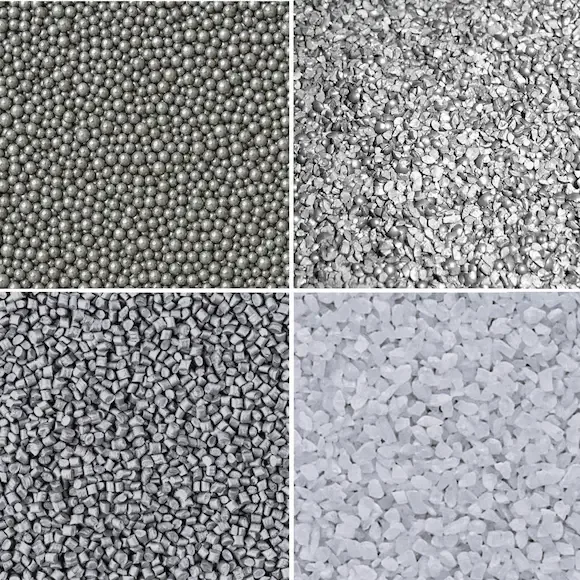
How to choose the best blasting abrasive
Which abrasive to use by material and process
Read more
FAQ
What is shot blasting abrasive?
Shot blasting abrasive — the material that defines process quality
Read more
Technical article
Steel shot vs. slag
Which suits you by service life, recovery and cost per cycle
Read moreABRASIVE SELECTION
Not sure which abrasive your process needs?
CYM Materiales helps you define it
Our technical team reviews the part material, the available equipment, the finish you are after and the applicable standard, and recommends the right type, size and hardness. Get in touch, with no obligation.
REQUEST ADVICE