
TECHNICAL ARTICLE
Integrated blasting and painting line
PROCESS INTEGRATION
Advantages and criteria for structural steel fabricators
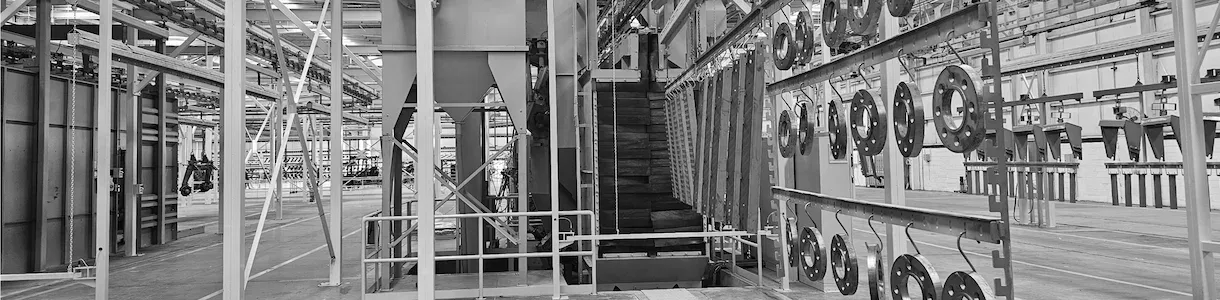
Manufacturers of steel structures, agricultural machinery, bodywork and industrial equipment face a recurring dilemma: blasting in one area and painting in another means moving parts, managing the re-oxidation window of bare steel and absorbing the risk of damage and quality variations in between. The integrated blast and paint line solves this problem by connecting both processes in a continuous flow. This report analyses when integration makes sense, what components a complete line includes and what measurable benefits it delivers.
The problem with separate processes
• Re-oxidation window: blast-cleaned steel is highly reactive. Depending on ambient temperature and relative humidity, it can begin to rust within a few hours. If the path between the blast machine and the paint booth is not controlled, the surface arrives contaminated at the coating application stage and adhesion is compromised from the start.
• Re-handling and damage: every transfer between processes involves cranes, forklifts, slings and operators. Each handling is an opportunity for mechanical damage to the already-prepared surface: dents, marks, grease contamination. On complex-geometry or large-format parts, the risk is proportional to size.
• Quality variability: when blasting and painting are independent processes — sometimes on different shifts, sometimes subcontracted — control over the complete sequence is fragmented. The final result depends on coordination between two processes that cannot see each other.
• Duplicated operating cost: two separate installations mean two ventilation systems, two extraction units, two loading and unloading areas, and idle time between processes. The cost per m² painted is systematically higher than in an equivalent continuous line.
Components of an integrated line
An integrated blast and paint line combines the following modules in a continuous sequential flow:
• Continuous-pass blast machine: the first link in the line. Removes mill scale, rust and contaminants from raw material or welded structures and generates the roughness profile for the coating. Parts advance suspended (overhead conveyor) or on rollers depending on geometry.
• Primer booth: application of the primary coating immediately after blast cleaning. The module can be a shop primer booth (on raw material lines: transitional coating of 15-25 µm that allows welding through it) or an anti-corrosion primer booth (on finished structure lines: first coat of the definitive paint system, greater thickness, not intended for subsequent welding). Proximity between the blast machine and the primer booth is the key element that eliminates the re-oxidation window: in high-output lines, the time between blasting and application can be just minutes.
• Drying or gelation oven: forces cure of the primer coat before continuing with fabrication (cutting, welding) or topcoat application. Reduces waiting time between coats and ensures adhesion of the complete system.
• Topcoat paint booth: application of the final paint system (anti-corrosion plus topcoat, or full system to customer specification). Can be liquid spray, electrocoating or powder coating depending on the process.
• Curing oven: cures the complete paint system. Guarantees the final hardness and adhesion of the coating.
• Overhead conveyor system (Power and Free or monorail): connects all modules and allows variable advance speed depending on the process time required at each station. Conveyor automation eliminates manual re-handling between modules.
When integration makes sense and when it does not
An integrated line is not the right solution for every case. The main decision criteria are:
• Production volume: the integrated line justifies its investment above a certain minimum production volume. For manufacturers with continuous output or high-repetition cycles (same part in large quantities), payback is fast and operating savings are significant.
• Part type: geometry, weight and dimensions of the part determine the compatible conveyor and blast machine type. Regular-geometry parts in continuous pass are the most suitable. Large-format or exceptionally complex structures may require a combined bay with semi-automated processes.
• Paint system: the coating system (liquid paint, powder, electrocoating, primer plus topcoat) defines the required modules and oven temperatures. Some systems require controlled temperature and humidity conditions throughout the line.
• Available plant space: an integrated line requires a linear layout with space for all modules in sequence. Space analysis is the first step in installation design.
• When separate processes still make sense: an independent paint booth remains valid for low-volume manufacturers, wide variety of non-repetitive parts, or when blasting and painting belong to production stages very distant in time.
Beneficios medibles de la línea integrada
• Elimination of re-oxidation: time between blasting and primer application is reduced from hours or days to minutes. The surface reaches the coating in optimal condition, with the roughness profile intact and no incipient rust.
• Reduced handling: the connected overhead conveyor eliminates manual transfers between processes. Fewer handlings means fewer damages, less internal logistics staff and lower total process time.
• Uniform finish: blasting, priming and curing parameters are constant across all parts. The final result is uniform part to part, facilitating quality certification and reducing rejects.
• Higher output per shift: continuous flow eliminates idle time between processes. Production per work shift on an integrated line is systematically higher than in separate processes of equivalent installed capacity.
• Lower cost per m² painted: the combination of lower labour consumption, lower total energy (shared ovens, unified ventilation) and lower rework rate reduces the operating cost per unit area painted.
• Full process traceability: in an integrated line, blasting and painting parameters are recorded in the same production cycle. This facilitates the traceability required by quality standards (ISO 9001, customer specifications) and root cause identification for non-conformances.
KEEP EXPLORING
Related equipment and content
TECHNICAL ARTICLE
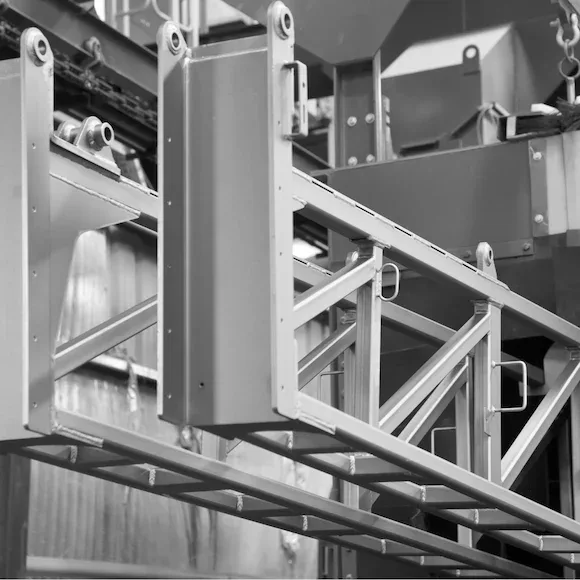
Shot blasting of steel profiles and welded structures
Two process stages: raw material before fabrication and finished structure before painting
Read more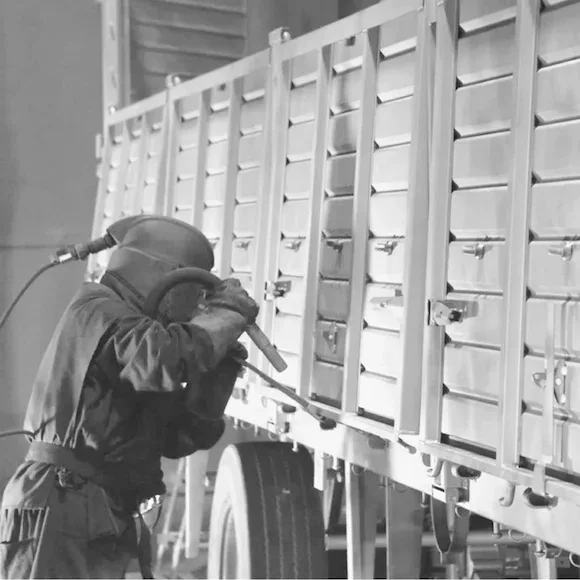
TECHNICAL ARTICLE
Corrosion in steel and the role of shot blasting
How surface preparation extends the service life of steel
Read more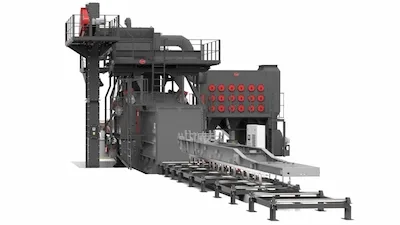
PER, EST & CH LINES
Shot blast machine for profiles and welded structures
Automatic shot blasting machines for profiles, tubes, spools and welded structures.
Read moreInstallations
Equipment in operation
Special Projects
CYM Materiales develops it
.webp?dpl=dpl_8peafvyWRW9zopoRDFAf9ZicXKd2)
Evaluating integrating your blasting process with a painting line?
Our Engineering and Sales team works alongside the client to design a custom solution, reducing operating costs and maximizing productivity. Every project starts with a detailed technical assessment and ends with a machine built and tested at our plant
Talk to a specialistPublished: July 2026