
FAQ
Shot blasting vs grinding before painting
GRINDING · PICKLING · SHOT BLASTING
Mill scale removal, anchor profile and traceability
The durability of an industrial coating depends almost entirely on surface preparation. A coating applied over a poorly prepared surface peels prematurely, regardless of paint quality. Mechanical grinding, rotary wire brushes and chemical pickling are common alternatives, but none achieves the results that shot blasting delivers in terms of cleanliness, anchor profile and traceability.
Why grinding and wire brushes are not enough
• Do not remove mill scale — mill scale (hot-rolling oxide scale bonded to steel) has a different electrical potential from the base steel and triggers galvanic corrosion under the paint. Grinding and brushes flatten it but do not remove it.
• Do not create a uniform profile— the roughness profile left is irregular and difficult to control, compromising coating adhesion.
• Not traceable — there is no cleanliness grade standard equivalent to the Sa grades of ISO 8501-1 for grinding; the result depends on the operator and cannot be certified.
Why chemical pickling has limitations
• Hydrogen embrittlement risk — on high-strength steels, acid pickling can introduce hydrogen into the crystalline structure, reducing material toughness.
• No mechanical anchor profile — acid dissolves the oxide but leaves a chemically clean and relatively smooth surface; paint adheres by surface tension, not mechanically.
• Toxic waste generation— pickling baths exhaust their capacity and must be treated or disposed of as hazardous waste, with high cost and logistical complexity.
• Rapid re-rusting without immediate coating — pickled steel is highly reactive and can re-rust within hours if the coating is not applied immediately.
What shot blasting provides that other methods do not
• Complete mill scale removal — abrasive projected mechanically at high speed detaches and removes mill scale without acids. It is the only process that guarantees complete removal.
• Controlled roughness profile (Ra / Rz) — abrasive type and size determine the profile. That profile can be specified, measured and certified to the coating standard.
• Traceable cleanliness grade (Sa / SP)— ISO 8501-1 and SSPC/AMPP define grades Sa 2, Sa 2½ and Sa 3, which can be visually verified and certified in the quality record.
• Standardisable and repeatable process — parameters (abrasive, speed, passes) can be fixed and reproduced, guaranteeing the same result across the entire production run.
Shot blasting vs. sanding vs. chemical pickling
| Criterion | Blasting | Sanding / brushes | Acid pickling |
|---|---|---|---|
| Mill-scale removal | Complete (the only one that guarantees it) | Does not remove it, only flattens it | Dissolves it with acid |
| Anchor profile | Controlled and measurable (Ra/Rz) | Irregular, hard to control | No profile: smooth surface |
| Traceability | Certifiable Sa/SP grade (ISO 8501-1) | Not traceable; depends on the operator | — |
| Risk / waste | Dry process, no hazardous waste | — | Hydrogen embrittlement; toxic waste |
Published: July 2026 - Updated: July 2026
KEEP EXPLORING
Related equipment and content
Installations
Equipment in operation
Special Projects
Can't find the equipment you need?
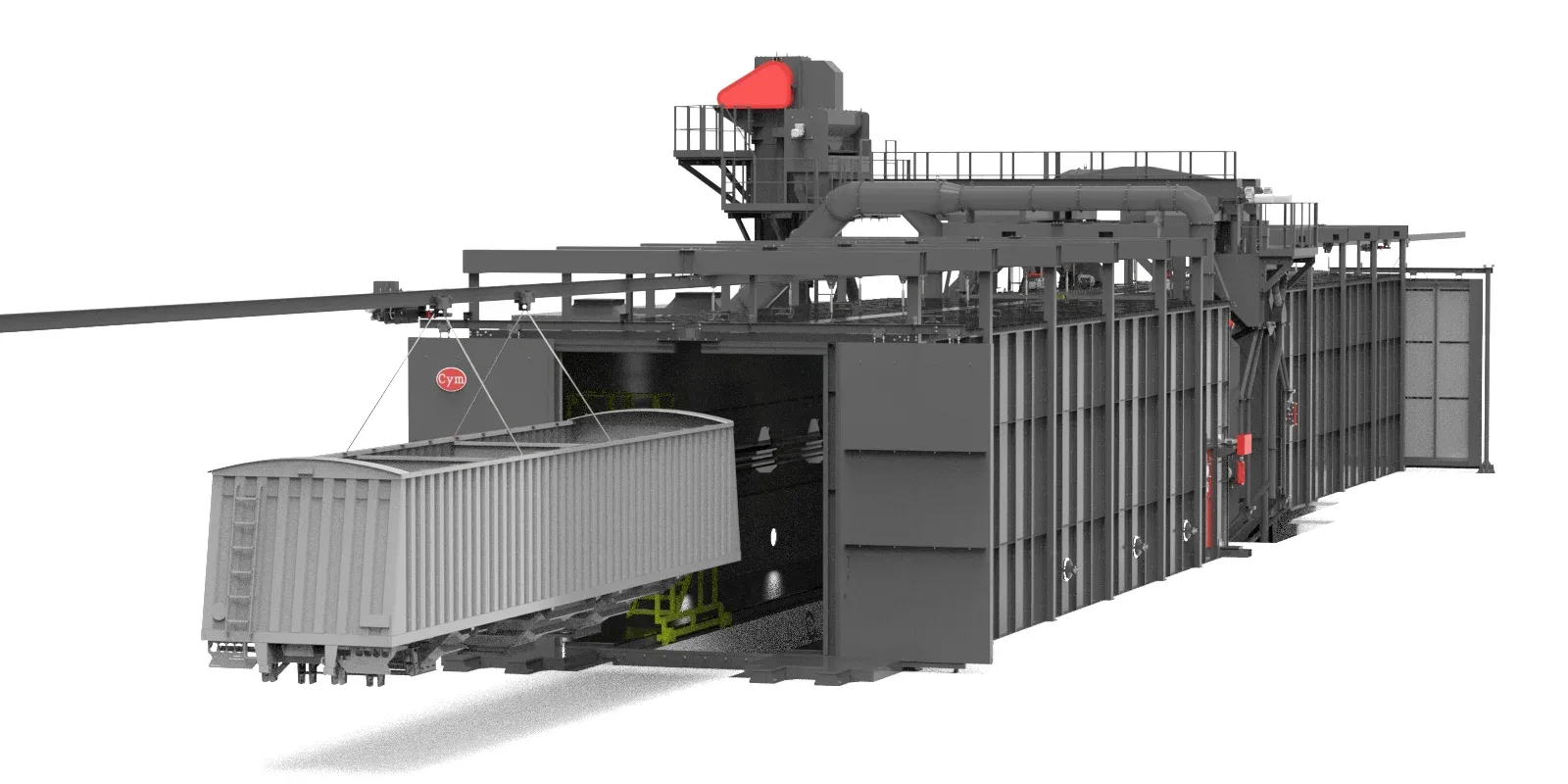
CYM Materiales develops it.
Our Engineering and Sales team works alongside the client to design a custom solution, reducing operating costs and maximizing productivity. Every project starts with a detailed technical assessment and ends with a machine built and tested at our plant
REQUEST A CUSTOM PROJECT