
faq
Why shot blast steel plate before cutting or welding?
RAW MATERIAL PREPARATION
A sounder weld bead, a cleaner cut and better paint adhesion
Hot-rolled steel plate arrives from the mill covered by a layer of mill scale and oxide. Shot blasting the plate as raw material —before cutting, drilling and welding— removes that layer and leaves the surface clean and with a roughness profile. Doing it at the start of the cycle improves every later operation, whatever equipment is used.
The most direct benefit is in welding.
Mill scale is an adhered oxide that interferes with thermal processes. When heated during welding it releases gases that get trapped in the bead and create porosity; its impurities can form non-metallic inclusions, and its higher melting point can prevent proper fusion between the base metal and the filler material. On clean plate, by contrast, the bead comes out sounder and more uniform. It is no minor detail: structural welding codes such as AWS D1.1 require removing mill scale on critical joints. The impact is greater with automatic or robotic welding, calibrated to work on clean steel, where mill scale causes repetitive defects and rework.
In thermal cutting, a uniform surface also makes a difference.
Shot blasting as preparation applies to thick hot-rolled plate, where mill scale is thicker and uneven. In plasma, oxy-fuel and especially laser cutting, that irregular scale makes the beam lose focus, peels off during the process and causes unstable cuts or piercing defects. A blasted, even surface gives a more consistent cut. On thin plate, by contrast, the usual preparation is pickling; shot blasting is reserved for thick gauges, where there is no risk of deforming the part.
Mill scale also ruins the finish.
It has a different electrochemical potential from the base steel, so when it is trapped under paint it causes galvanic corrosion and the coating peels prematurely. It is also brittle and poorly adhered: any paint applied over it comes off together with the scale. That is why blasting before fabrication, while the plate is still flat —the simplest geometry to treat—, leaves the surface uniform and ready.
And it leaves the surface pre-blasted for the rest of the process.
Most small shops do not apply shop primer over that plate, but the benefit carries through anyway: if a final blasting of the welded structure is needed later —which the small shop usually does by hand, in a blast room— that manual work is much faster, because the surface is already pre-treated and only the welding contaminants have to be removed, not the base oxide of the whole part.
What equipment should be used to shot blast the sheet metal?
Blasting plate as raw material can be done with different equipment depending on the scale of the shop: from a portable floor blasting machine for low volumes, to dedicated automatic lines for profiles, structures and plate in continuous production. The method changes; the fundamentals are the same.
Equipment lines
Select the equipment for your application
.webp?dpl=dpl_8peafvyWRW9zopoRDFAf9ZicXKd2)
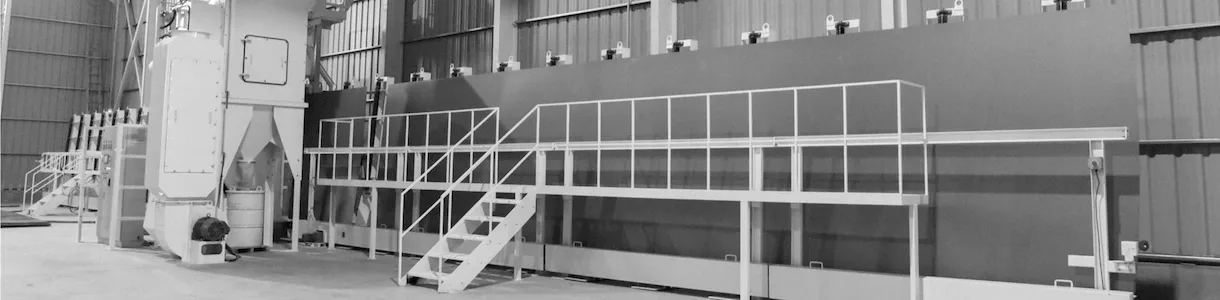
LINE CH-V
Vertical-pass plate shot blast machine
No brushes or blowers needed, eliminating abrasive buildup points. Lower investment and maintenance cost than horizontal-pass machines.
Read more.webp?dpl=dpl_8peafvyWRW9zopoRDFAf9ZicXKd2)
CH-H LINE
Horizontal pass plate and H-profile shot blast machine
Integrable with shop primer booth and drying oven for a complete surface preparation and coating line.
Read more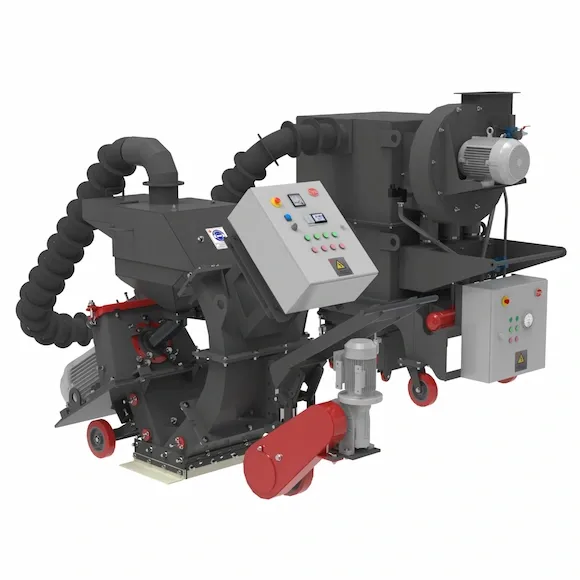
products
Portable turbine blast machines
Large-surface treatment on site, with no fixed installation
Read moreKEEP EXPLORING
Related equipment and content
Technical article
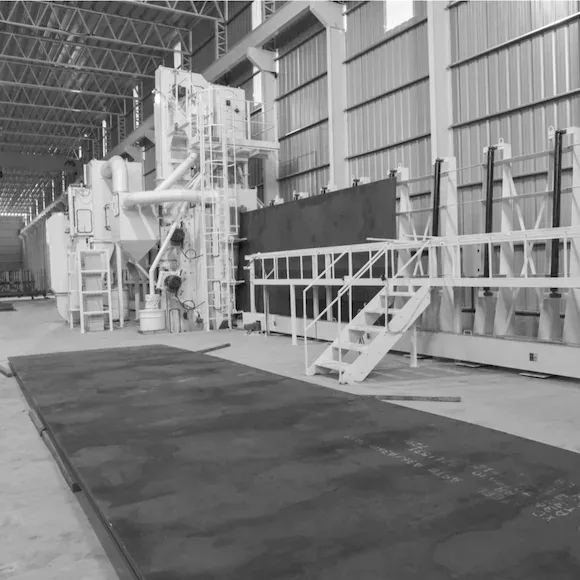
Horizontal or vertical steel plate shot blasting
Process fundamentals — selection guide
Read more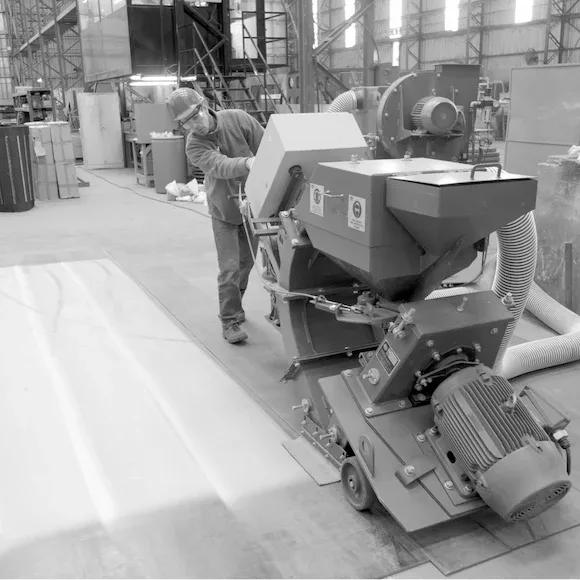
TECHNICAL ARTICLES
Steel plate shot blasting with a portable wheel machine
Lower investment and less space to remove mill scale and prepare plate
Read more
TECHNICAL ARTICLE
Shot blasting of steel profiles and welded structures
Two process stages: raw material before fabrication and finished structure before painting
Read moreInstallations
Equipment in operation
VIDEOS
Equipment in action
Special Projects
Can't find the equipment you need?
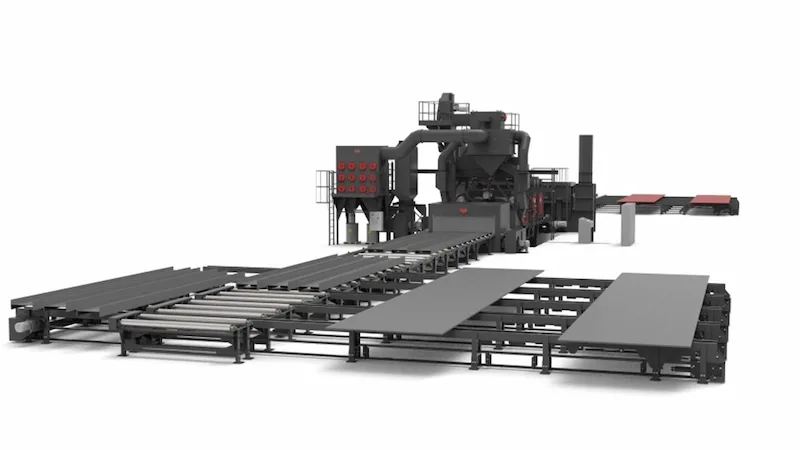
CYM Materiales develops it.
Our Engineering and Sales team works alongside the client to design a custom solution, reducing operating costs and maximizing productivity. Every project starts with a detailed technical assessment and ends with a machine built and tested at our plant
REQUEST A CUSTOM PROJECTPublished: July 2026