
TECHNICAL ARTICLES
Post-casting heat treatments
CASTING FINISHING
What each treatment adds to the part's properties
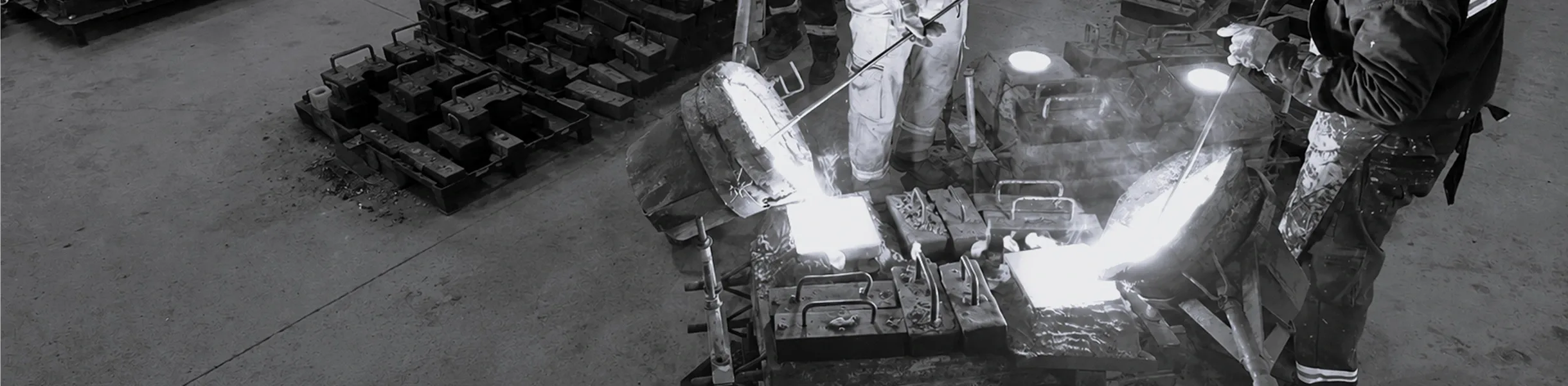
Casting the part is only half the job. Straight out of the mold, the steel has a heterogeneous internal structure and stresses built up by uneven cooling; it does not yet deliver the mechanical properties its alloy is capable of. Post-casting heat treatment is the step that transforms that structure into final hardness, toughness and stability. It is not an extra: without the right treatment, a cast part does not deliver what its composition promises.
1. What happens to the part out of the mold
Cooling inside the mold is not uniform: thick sections solidify more slowly than thin ones. That leaves a coarse, uneven grain structure, with alloy segregation and internal residual stresses. A part in that state is brittle, hard to machine evenly, and has properties that vary from point to point. Heat treatment corrects that inheritance from the mold.
2. Annealing: homogenize and soften
Annealing heats the part and cools it slowly and under control. It serves to soften the material and homogenize the structure: it distributes the alloying elements more evenly, relieves stresses and leaves the part softer and more stable. It is key before machining —a homogeneous, soft material machines better, with less tool wear— and as a base for later treatments.
3. Normalizing: refine the grain
Normalizing also heats the part, but cools it in air. The result is a finer, more uniform grain throughout the part, with a better combination of strength and toughness than the as-cast structure. It is the treatment that erases the mold's «memory» and leaves even, predictable properties, a reliable starting point for structural parts.
4. Quench and temper: hardness with toughness
When the part needs hardness —due to wear or high mechanical demand— the quench-and-temper pair is used. Quenching cools fast to harden the steel, but leaves it hard and brittle at the same time. The tempering that follows restores toughness and adjusts the hardness to the exact point the part needs. That is why you never quench without tempering: a part that is only quenched is a part that breaks.
5. How the treatment is chosen for the part
There is no «best» treatment: there is the right one for each part. It depends on the alloy and, above all, on how the part will work: if it suffers wear, hardness is sought (quench and temper); if it takes impact, toughness is prioritized; if it will be machined a lot, it is softened first. That is why heat treatment is part of the part's specification, not a final add-on —it is defined together with the alloy, according to service.
CONCLUSION
The alloy promises; the treatment delivers
Composition defines what a cast part is capable of; heat treatment is what makes that capability show. Annealing, normalizing, and quench and temper are not interchangeable steps: each one adjusts the structure for a purpose. CYM Materiales performs heat treatment in-house, integrated with casting, machining and quality control under ISO 9001:2015, to deliver a part with the properties its application demands.
Special Projects
Do you need a custom part that's not in our catalog?
CYM Materials will develop it for you.
Our technical team analyzes each requirement and develops the most suitable solution: from alloy selection and model design to the finished part, ready for installation. Contact us for a free consultation.
CONSULTAR SELEÇÃOPublished: July 2026