
TECHNICAL ARTICLES
Shot blasting of cast parts
CASTING FINISHING
Why it is a technical step and not just cosmetic
A part fresh out of the mold is not ready to use: it comes covered in molding sand, mill scale and remains from shakeout. The shot blasting that follows is not a matter of tidiness or of making it "look nice". It is a technical step that conditions the part for everything that comes next: inspecting it, machining it, coating it and putting it into service with confidence. For a foundry or a shop producing in volume, getting that step right defines both quality and productivity.
1. What comes out of the mold and why it is not usable as-cast
The as-cast part carries everything the process left behind: molding sand stuck to the surface, burnt-on sand embedded where the metal was hottest, mill scale formed on cooling, and remains of the feeding system. That layer is neither superficial nor even: it hides the real shape of the part and contaminates any later operation. Trying to machine, inspect or coat over it means working blind.
In a steel foundry, moreover, it is best to blast right after shakeout, before cutting the risers: removing the abrasive sand first keeps it from damaging the cutting tools and leaves the rest of the process working on a clean surface.
2. What shot blasting does to the cast part
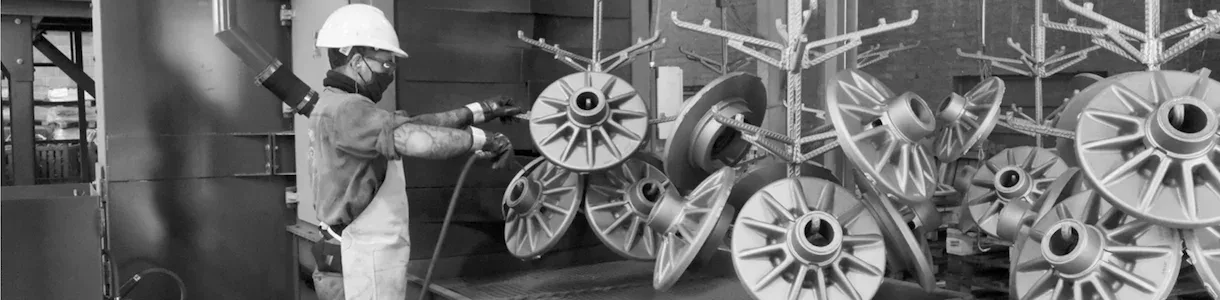
Shot blasting propels steel shot at high speed against the part. The impact strips off the sand, the mill scale and the oxides uniformly across the entire surface, including cavities and recesses that hand brushing cannot reach. The result is a clean, homogeneous metal surface with an even roughness, treated repeatably part after part. For the detail of the process itself, we link to the introduction-to-shot-blasting article.
3. It reveals the real part: inspection and defect detection
On a dirty part, defects stay hidden. Once blasted, the clean surface exposes porosity, shrinkage cavities, cracks and inclusions that the sand and scale concealed. That is why shot blasting is a precondition for visual inspection and non-destructive testing: without it, a critical defect can go unnoticed until the part fails in service. Here it is clear that shot blasting is functional, not cosmetic.
4. It prepares machining
Molding sand is abrasive and hard. If the part reaches the lathe or the mill with sand still on it, that sand wears and chips the cutting edge, shortens tool life and raises machining cost. Blasting before machining removes that abrasive and delivers clean, stable reference and clamping surfaces, improving dimensional repeatability. It pays for itself in longer-lasting tools and fewer rejected parts.
5. It enables coating adhesion
A cast part that will be painted, phosphated or coated needs a clean surface with mechanical anchoring. Over mill scale and oxides, any coating peels off: the film bonds to the dirt, not to the metal. The profile left by blasting provides the anchoring the coating needs to last. Surface preparation for coating has its own criteria; we link to the specific article.
6. Doing it well and in volume: the right equipment
Shot blasting works when it is a controlled process, not improvised polishing. Many foundries turn to rotary table blast machines: they are valid for certain parts, but for complete blasting they perform worse, because their geometry usually means the part needs two or more cycles to be 100% blasted, with more machine time and handling. To achieve full coverage in a single process, the right machine depends on the type of part:
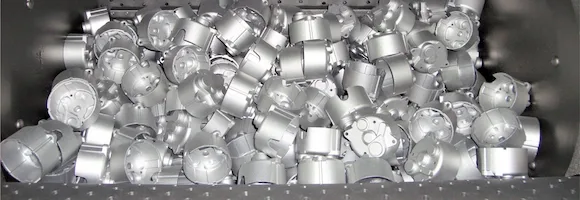
TUMBLE BELT BLAST MACHINE
- Small, bulk cast parts that tolerate tumbling
- Desanding of ferrous and non-ferrous cast parts
- Controlled tumbling for uniform coverage without damaging the parts
- Removal of oxides, mill scale and scale
- Deburring together with cleaning, in a single cycle
- Rubber belts for delicate parts or steel belts for heavy duty
- Designed for high volumes of small parts
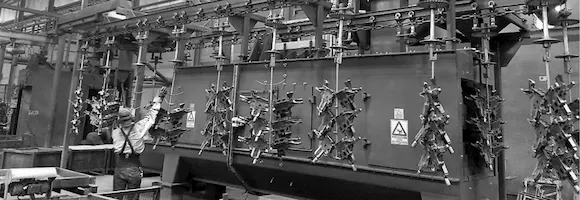
SPINNER HANGER BLAST MACHINE
- Medium and large cast parts that are hung and not tumbled
- Processes parts of any size, shape and complexity
- Rotating hanger: full coverage without handling each part
- Interchangeable hangers to suit each type of part
- Fixed, mobile, double or multiple hook options on rails
- Simultaneous loading and unloading on double-hook machines
- High production volume without interruptions
CONCLUSION
Blasting does not finish the part: it enables it
Shot blasting a cast part is not the final cosmetic touch: it is the step that makes it inspectable, machinable and paintable, and that conditions its performance in service. Doing it well —with the right abrasive, intensity and machine for each type of part— is what separates a reliable part from one that fails later. CYM Materiales builds its own shot blasting machines and uses them in its own foundry: it designs and builds the equipment that solves that step, mastering the process end to end.
Published: July 2026
KEEP EXPLORING
Related equipment and content
TECHNICAL ARTICLES
Spinner hanger, rotary table or tumble belt machine
How to choose the machine by the type of part
Read more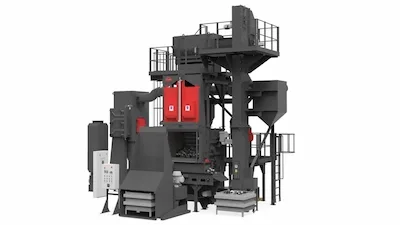
LT & LT-TAM LINE
Tumblast belt shot blast
Bulk parts: forgings, castings, auto parts. 1 or 2 blast wheels
Read more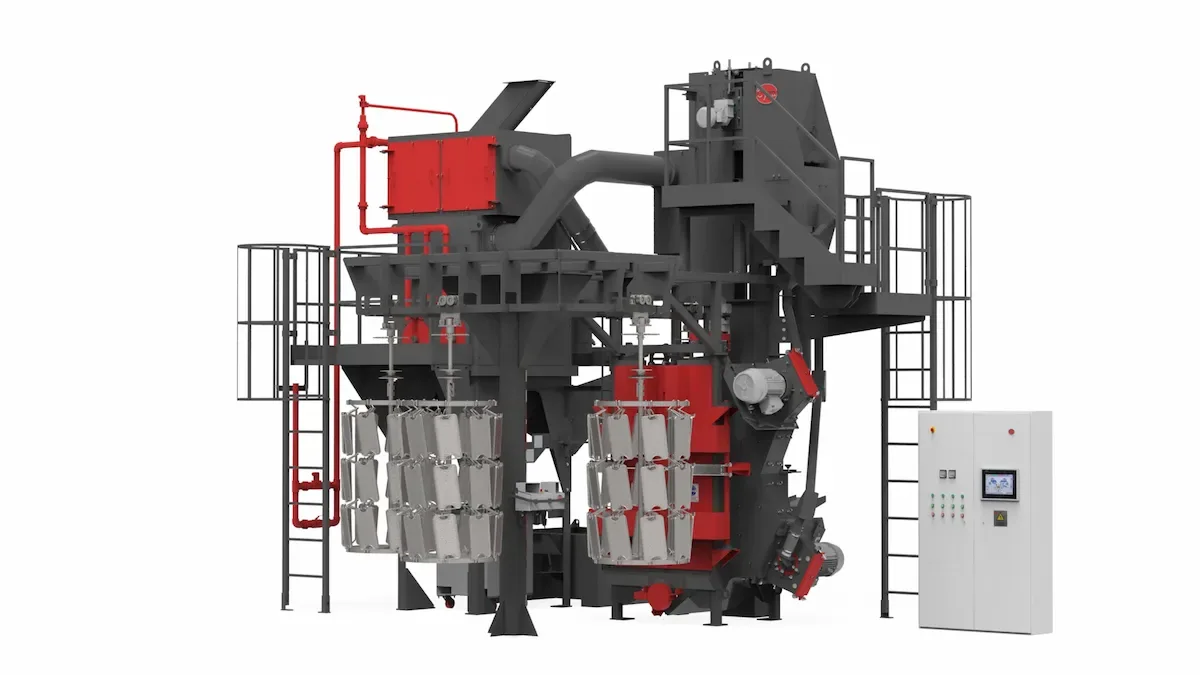
CAB, CAB-TUN & EST-TUN LINE
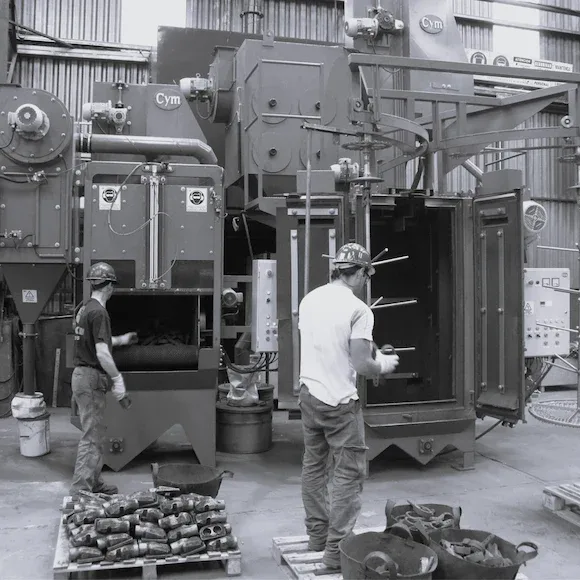
Spinner hanger
With fixed, moving, or oval hook for parts that cannot be bulk blasted.
Read moreInstallations
Equipment in operation
videos
Equipment in action
Special Projects
Can't find the equipment you need?
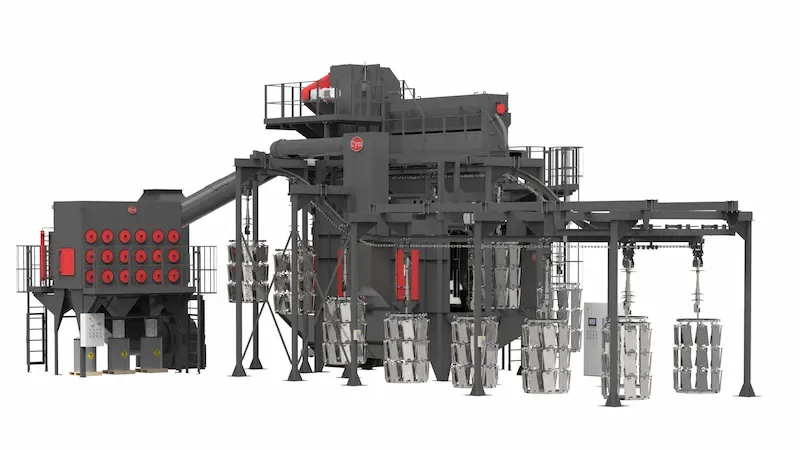
CYM Materiales develops it.
Our Engineering and Sales team works alongside the client to design a custom solution, reducing operating costs and maximizing productivity. Every project starts with a detailed technical assessment and ends with a machine built and tested at our plant
REQUEST A CUSTOM PROJECT