
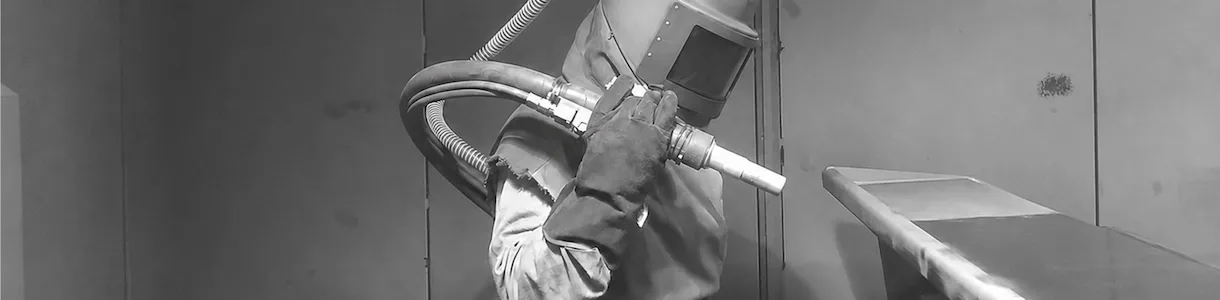
Technical article
How to choose the best blasting abrasive
SELECTION GUIDE
Which abrasive to use by material and process
Choosing the right abrasive is what determines finish quality, cost per square meter and the productivity of the whole process. CYM Materiales offers the full line —metallic and mineral abrasives— to cover the needs of every job.
The first decision depends on the equipment. Compressed-air systems work with any abrasive, so a single installation can use whichever best suits the material and the goal. Centrifugal blast wheel equipment, on the other hand, uses metallic abrasives only (carbon or stainless steel abrasive). From there, the choice is refined by the material to be treated, the desired result and the cost. In this guide we review each abrasive and close with a selection table by material and by process.
The available abrasives
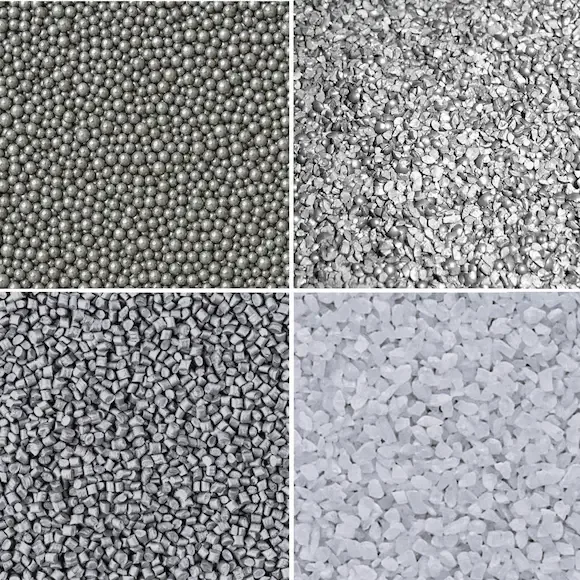
Each abrasive has a profile of hardness, shape, recyclability and cost that makes it more or less suitable for the job. These are the main ones:
Steel abrasive (carbon or stainless)
• Produced from steel by melting with controlled composition: spherical particles (shot) which, on fracturing, yield the angular form (grit).
• On blast wheels, shot, grit or a mix are used; when replacing sand, almost always grit.
• Highly recyclable: 700 to 5,000 times depending on diameter, type and hardness. It does not contaminate (quenched-and-tempered steel) and needs no drying.
Glass beads
• For surface preparation and cleaning, decorative finishes, etching and shot peening.
• Removes no base metal and leaves no embedment: achieves a fine, clean finish.
• Suitable when the part must not be contaminated or dimensionally altered (stainless steel, non-ferrous).
Aluminum oxide (alumina)
• Synthetic mineral (Al₂O₃) made from bauxite; the brown grade has at least 95% Al₂O₃.
• High hardness and sharp edges → an aggressive abrasive, ideal for demanding descaling.
• Recyclable 10 to 40 times depending on use and material.
Garnet (almandine)
• Natural silicate mineral, chemically inert, with no quartz or toxic components (an advantage over sand).
• Hardness and shape that make it aggressive; widely used in sandblasting.
• Recyclable up to about 5 times.
Slag
• By-product of metallurgical melting or combustion (copper, nickel, coal, blast-furnace slag).
• Very sharp edges but high fragility → not recyclable, high consumption per m².
• A low initial-cost option for single-use abrasive descaling.
Silica sand
• The historical abrasive (it gives sandblasting its name); silica is used, never calcareous.
• Very fragile: single use (over 80% turns to dust on the first impact), generating heavy pollution.
• Releases free silica, the cause of silicosis: banned or restricted in most advanced countries.
Abrasive selection table
This table summarizes which abrasive is suitable for each material to be treated. The reference runs from optimal to prohibited.
●● Optimal · ● Recommended · – Not recommended · ✕ Prohibited
| Material | Glass beads | Aluminum oxide | Organic | Plastic | Garnet & slag | Silica sand | Sodium bicarb. | Calcium carb. | Carbon steel shot | Stainless steel shot |
|---|---|---|---|---|---|---|---|---|---|---|
| Steel | ●● | ●● | – | – | ● | X | – | – | ●● | – |
| Stainless steel | ●● | – | – | – | – | X | – | – | – | ●● |
| Non-ferrous alloys | ●● | – | – | – | – | X | – | – | – | ●● |
| Aluminum | ●● | – | – | – | – | X | – | – | – | ●● |
| Wood | ●● | ● | – | – | ● | X | – | – | – | ●● |
| Marble & granite | – | ●● | – | – | ● | X | – | – | – | ●● |
| Various plastics | ●● | – | ●● | ●● | – | X | ●● | ●● | – | – |
| Glass | ● | ●● | – | – | – | X | ●● | ●● | – | – |
KEEP EXPLORING
Related equipment and content
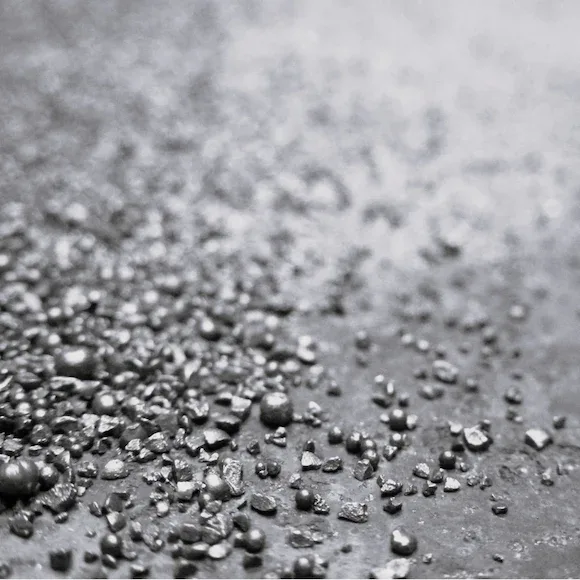
FAQ
What is shot blasting abrasive?
Shot blasting abrasive — the material that defines process quality
Read more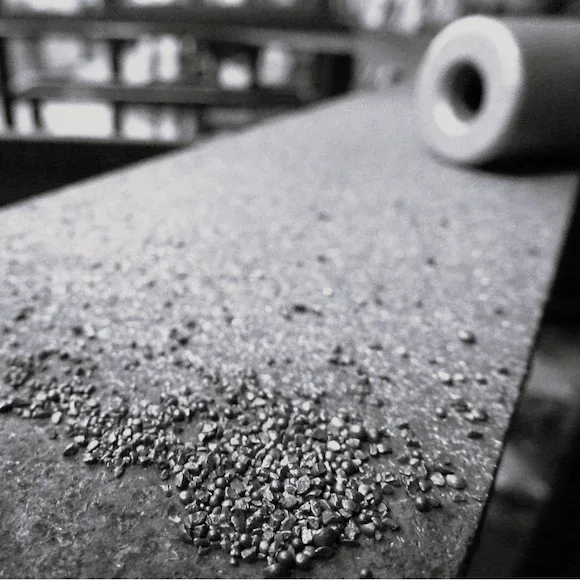
Technical article
Steel shot vs. silica sand
Steel shot or sand: which is better in enclosed spaces
Read more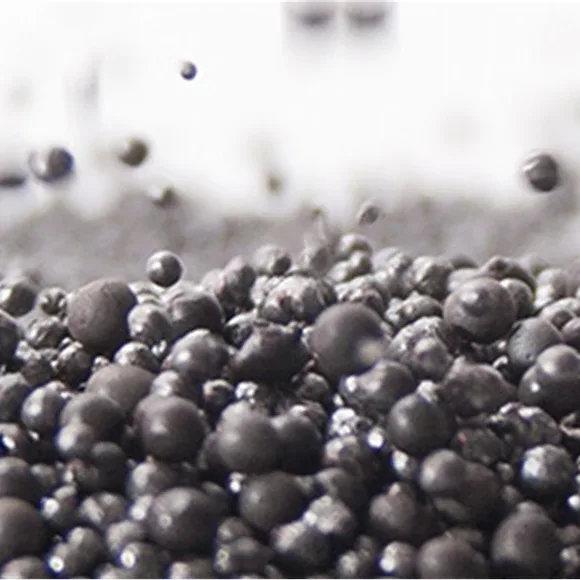
PRODUCT
Abrasives for blasting
How to choose the abrasive by equipment and finish
Read moreInstallations
Equipment in operation
videos
Equipment in action
ABRASIVE SELECTION
Not sure which abrasive your process needs?
CYM Materiales helps you define it
Our technical team reviews the part material, the available equipment, the finish you are after and the applicable standard, and recommends the right type, size and hardness. Get in touch, with no obligation.
REQUEST ADVICEPublished: June 2026