
Technical article
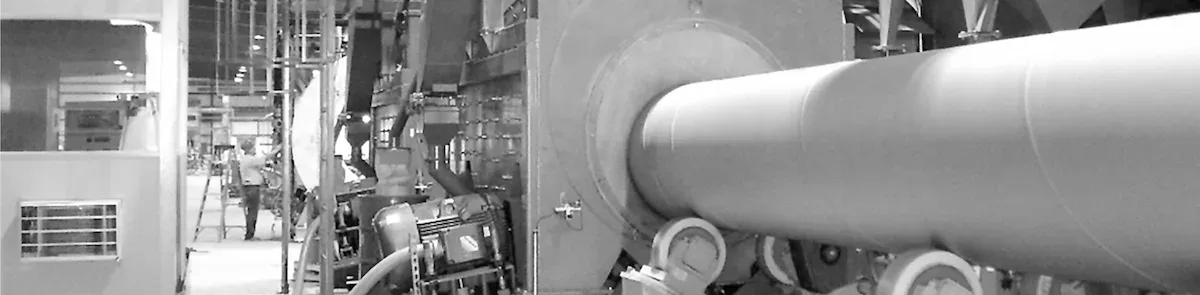
Tube shot blasting with two machines in line
PRODUCTION LINE
One machine cleans, the other creates the profile: more output and uniform quality
The service life of a pipe coating depends as much on the quality of the coating as on the surface preparation beforehand. That preparation has two objectives: removing contaminants from the surface (cleaning) and generating the roughness profile needed for the coating to adhere. Shot blasting achieves both in a single pass, but there is a problem: the optimal conditions for each objective are opposite. A single machine works at a compromise setting that is never best for either.
Two objectives, two opposite settings
The main variable in a shot blasting process is the operating mix: the distribution of particle sizes in circulation.
For cleaning, the ideal mix has a wide size range: large particles provide the kinetic energy to remove stubborn contaminants, while smaller ones, in greater numbers, achieve full coverage. The recommended setting is to discard particles below 25 % of the nominal size of new shot.
For surface profile, the situation is the opposite. Roughness depends on the kinetic energy of each impact, which is a cubic function of particle size; if the size range is wide, the resulting profile is unstable and uneven. The ideal mix has a narrow range, discarding particles below 50 % of the nominal size.
Both settings are incompatible: with a single machine, a compromise point is set where neither objective is achieved at its best performance.
Why two inline machines solve the problem
With two shot blasting machines inline, each is set independently for its designated objective, with no compromise.
Machine 1: shot blasting for cleaning
The first machine runs a wide-range mix with a 25 % discard threshold. It also receives approximately 30 % of the material discarded by machine 2 —which would otherwise be wasted— reusing it as part of the cleaning mix. The fresh shot input is reduced to around 70 %. This machine removes the bulk of surface contaminants, leaving the surface in optimal conditions for the second machine.
Machine 2: shot blasting for surface profile
The second machine runs a narrow-range mix with a 50 % discard threshold. It works on a surface already cleaned by the first machine, which improves the quality of the profile achieved and substantially reduces the risk of contamination between the pipe surface and the coating — the main cause of premature coating failure.
Both In-Line Machines: Configuration of Each One
| Parameter | Machine 1 — Cleaning | Machine 2 — Anchor profile |
|---|---|---|
| Goal | Remove surface contaminants | Create the roughness profile for adhesion |
| Shot mix | Wide size range | Narrow range |
| Discard (classification) | From 25% of nominal size | From 50% of nominal size |
| Why that mix | Large particles add energy; small ones, coverage | Roughness is a cubic function of size: a wide range gives an irregular profile |
| Reuses material | Yes — takes ~30% of Machine 2's discard | — |
| New shot | Reduced to ~70% of the charge | — |
| Works on | Incoming surface (with contaminants) | Surface already cleaned by Machine 1 |
Result: with both machines correctly set, output can double while keeping a cost per m² similar to a single machine. Process requirement: pipes must enter free of oil and grease (blasting does not remove them).
Additional benefits: output and coating quality
• Most coating failures originate from contamination between the pipe surface and the coating. Machine 2 works on a cleaner surface, significantly lowering that probability.
• With the correct setting of both machines, output can double while keeping a similar cost per m² to a single machine.
• The high-demand pipe coating industry — gas, oil and water pipelines — recognizes the need for two inline machines for this type of process.
One limitation to keep in mind: oils and greases
Shot blasting does not remove oils or greases. Pipes must enter the machines free of oil residue on their surface. In a two-machine system the risk of contamination failure is lower than with a single machine, but the requirement for oil-free pipe entry remains a process prerequisite.
To define the equipment for your pipe diameter, required output and coating type, our team can advise you.
KEEP EXPLORING
Related equipment and content
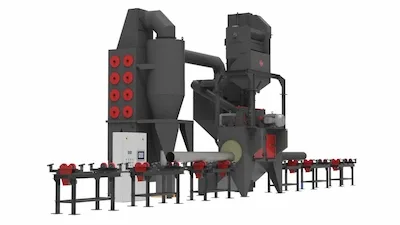
TUB, PER & TUB-I LINE
Tube shot blasting
Pipe shot blasting by centrifugal blast wheel, for both external and internal treatment in high-productivity continuous process
Read more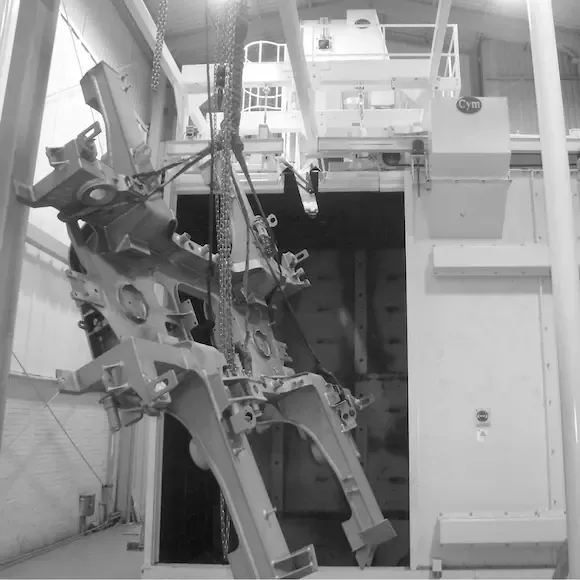
TECHNICAL ARTICLE
Surface preparation before coating
How to do it right for each coating
Read more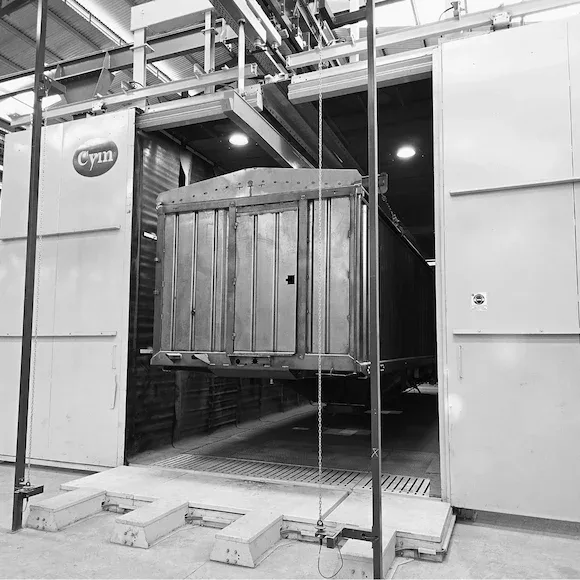
FAQ
What surface preparation grade do I need?
How to choose the grade by coating and environment
Read moreInstallations
Equipment in operation
Special Projects
Can't find the equipment you need?
CYM Materiales develops it.
Our Engineering and Sales team works alongside the client to design a custom solution, reducing operating costs and maximizing productivity. Every project starts with a detailed technical assessment and ends with a machine built and tested at our plant
REQUEST A CUSTOM PROJECTPublished: June 2026 - Updated: July 2026