
FAQ
What is the Almen strip test and how is it done?
SHOT PEENING
Almen test — the standard method for measuring shot peening intensity
The Almen test is the standardized method for measuring shot peening process intensity. It was developed by J.O. Almen in 1930 and is standardized by SAE J441, J442 and J443. It is the only internationally accepted method for verifying and certifying the parameters of a shot peening process.
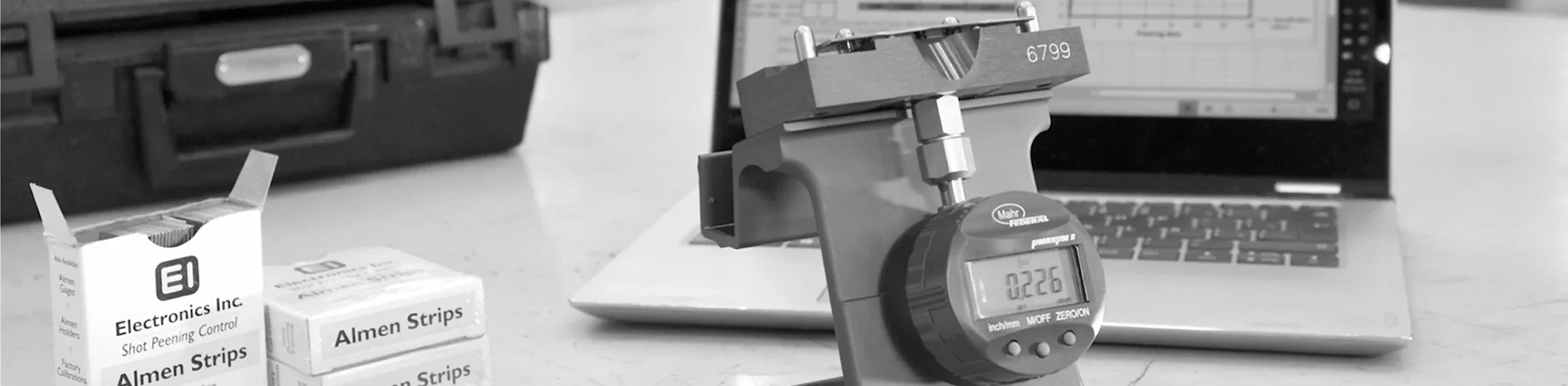
The test principle is based on the deformation of a standard test piece — the Almen strip — when subjected to the flow of spherical particles under process conditions. The strip is manufactured in special steel under strict hardness and flatness tolerances. When the abrasive impacts one face, the induced compressive stresses cause the strip to curve toward the impacted side. The height of that arc, measured with the Almen gauge (precision dial indicator), is proportional to the process intensity.
Almen strips are grouped into three types according to their thickness: type N (0.79 mm) for low intensities, type A (1.30 mm) for medium intensities — the most common in industry — and type C (2.29 mm) for high intensities.
The test procedure consists of fixing the strip in the standard holder, exposing the active face to the abrasive flow for the defined process time, removing the strip and measuring the arc height with the Almen gauge. To determine the saturation point — the process acceptance criterion — tests are carried out at different exposure times. The saturation point is reached when doubling the exposure time produces an arc height increase of less than 10%.
KEEP EXPLORING
Related equipment and content
FAQ
what is shot peening?
Surface treatment to increase fatigue resistance
Read more
Technical article
Why shot peening must be automatic and controlled
Repeatability, traceability and why an “eyeballed” process fails on fatigue parts
Shot peening has an un
Productos
Shot Peening machines
Equipment to increase fatigue resistance
Read moreInstallations
Equipment in operation
Special Projects
Can't find the equipment you need?
CYM Materiales develops it.
Our Engineering and Sales team works alongside the client to design a custom solution, reducing operating costs and maximizing productivity. Every project starts with a detailed technical assessment and ends with a machine built and tested at our plant
REQUEST A CUSTOM PROJECTPublished: June 2026