
Technical article
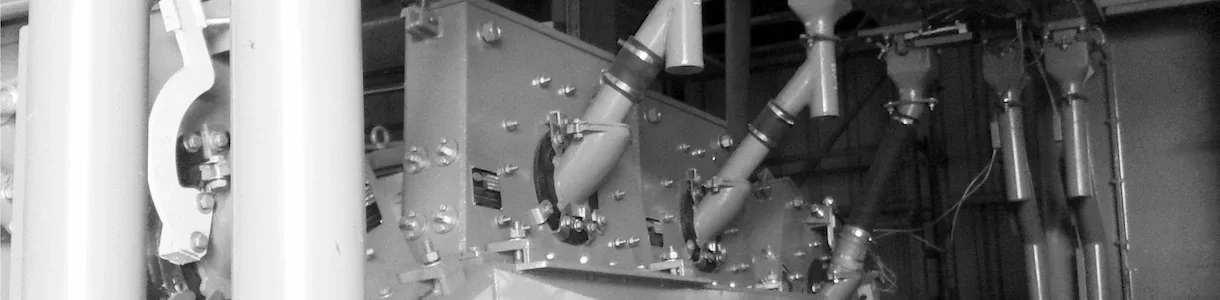
Double blast wheel in tumblast shot blasting
One or two wheels?
Why a single wheel leaves uneven coverage and how the second one removes dead zones
In rotary-belt shot blasting machines —also known as tumblast— a single blast wheel does not spread the shot evenly across the load. CYM Materiales studied this behavior and confirmed that working with two blast wheels substantially improves shot blasting performance. The following explains the problem, the test that measured it, and the concrete advantages of the double blast wheel.
The problem: uneven distribution and the “hot spot”
Operators of rotary-belt machines, especially medium and large single-wheel units, often cannot shorten blasting times without losing quality. When the cycle is cut short, parts in the center of the load are well blasted, but those at the ends —near the discs— are not.
The reason is that the shot thrown by a blast wheel concentrates in the center of the pattern, in an area known as the hot spot. As the stream moves away from that point, the amount of abrasive drops to around 50 %. To give the parts at the ends a coverage similar to those in the center, the cycle must be lengthened or parts sorted by hand —and in both cases operating costs rise significantly.
The engineering study and its results
To solve this, the CYM Materiales engineering department built a rig specifically designed to measure exactly how shot is distributed across the entire pattern thrown by a blast wheel.
Variables tested
• Different blast wheel models and diameters.
• Abrasive stream openings at varying RPM.
• Blast wheels with different blade counts and positions, and different shot types.
Results
• With two blast wheels adding up to the same installed power as a single one, the abrasive is distributed far more evenly across the whole load.
• By striking the parts from different impact angles, finish uniformity improves markedly compared with the old single-wheel design.
• Each machine model requires correct blast wheel positioning so the streams do not cross and performance is optimal.
Advantages of working with two blast wheels
• Blasting time reduced by 40 % to 50 %, with similar installed power.
• Lower maintenance cost through better use of the equipment.
• Lower shot consumption per finished part.
• Lower power consumption per blasted part.
• Lower labor cost.
• Greater consistency in finish quality.
Upgrading older machines
With simple modifications, a single-wheel rotary-belt machine —of any brand— can be upgraded to two blast wheels. It is a way to expand production capacity with low investment and a quick return, making the most of existing equipment.
Published: June 2026
Published: June 2026
KEEP EXPLORING
Related equipment and content
TECHNICAL ARTICLES
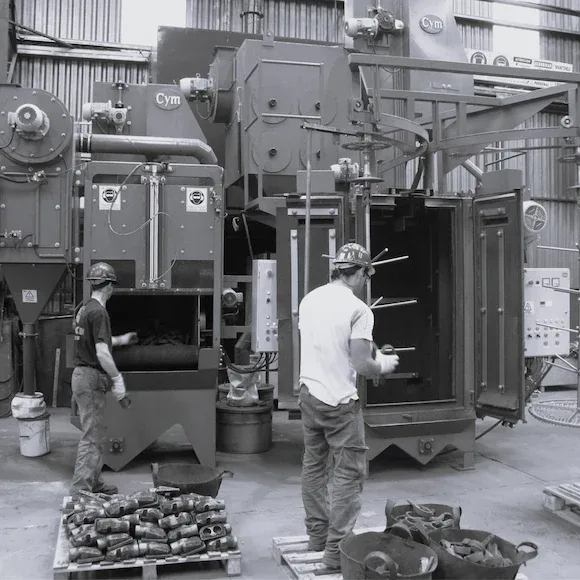
Spinner hanger, rotary table or tumble belt machine
How to choose the machine by the type of part
Read more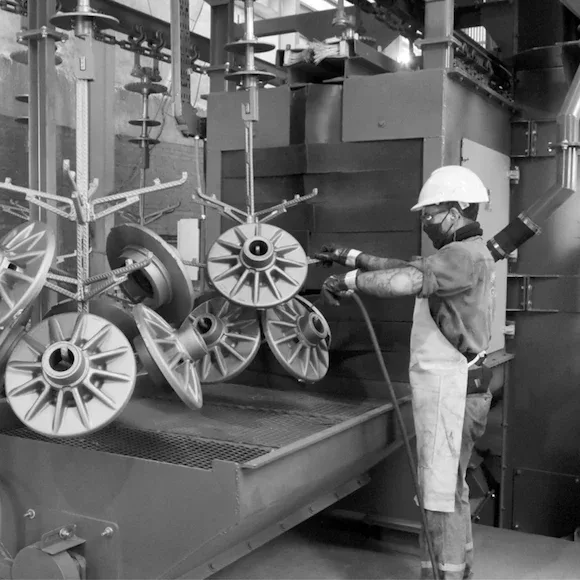
Technical article
Shot blasting of cast parts
Why it is a technical step and not just cosmetic
Read more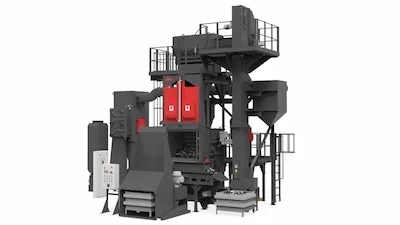
LT & LT-TAM LINE
Tumblast belt shot blast
Bulk parts: forgings, castings, auto parts. 1 or 2 blast wheels
Read moreInstallations
Equipment in operation
videos
Equipment in action
Special Projects
Can't find the equipment you need?
CYM Materiales develops it.
Our Engineering and Sales team works alongside the client to design a custom solution, reducing operating costs and maximizing productivity. Every project starts with a detailed technical assessment and ends with a machine built and tested at our plant
REQUEST A CUSTOM PROJECT