

Technical article
Introduction to the shot blasting process
PROCESS FUNDAMENTALS
The six systems of a machine, the abrasives and their applications
Shot blasting is an impact surface-treatment process: abrasive particles are projected at high speed —between 65 and 110 m/s (213 to 361 ft/s)— against the surface of a part, removing rust, mill scale, casting sand, old paint and other contaminants. The result is a clean surface with a controlled roughness profile, on a wide range of metallic and non-metallic parts.
That roughness profile —known as the anchor profile— is key to the adhesion of paints, anticorrosive coatings and metallizing. But shot blasting goes beyond coating preparation: it is also used for the mechanical descaling of wires, bars and plates, for shot peening to increase fatigue resistance, and for cleaning and sand removal of casting and forging parts. In this article we review how the process works, the six systems that make up a shot blasting machine, the available abrasives and the industries that use it.
What is shot blasting used for?
Shot blasting serves different purposes depending on the part and the desired result. Its main applications are:
- Sand removal and mill-scale removal on ferrous and non-ferrous castings and on forged parts.
- Mechanical descaling of wires, bars, plates and strip — an alternative to acid pickling, with no effluents and no hydrogen embrittlement.
- Shot peening, which induces compressive stresses on the surface and increases the fatigue resistance of springs, leaf springs and gears.
- Surface preparation prior to paint, anticorrosive coatings, rubber lining and other coatings.
- Shot blasting of concrete floors for coating application, and roughness restoration or rubber removal on airport runways.
How does shot blasting work?
In essence, shot blasting bombards the surface with abrasive particles at high speed. On impact, the abrasive strips off the adhered contaminants and leaves the surface clean and with the desired roughness. Impact speed, abrasive type and size, and projection angle determine the cleanliness grade and the anchor profile obtained.
Until the 1930s, shot blasting was done only with compressed air and nozzles. That method remains irreplaceable for certain jobs —such as the maintenance of already-erected structures— where the part cannot be brought to a machine.
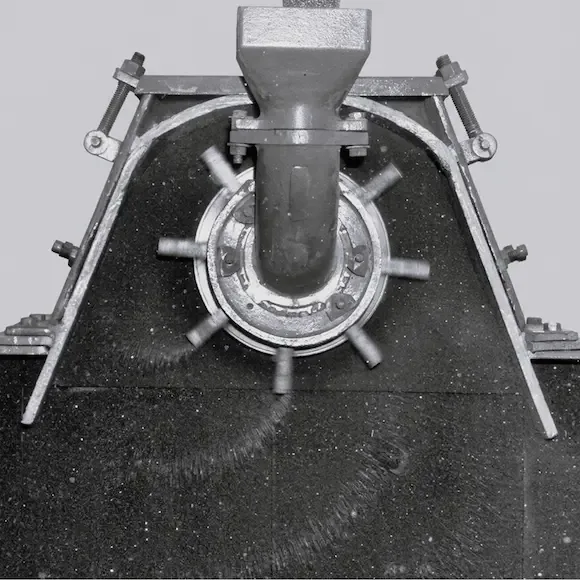
Automatic shot blasting on production lines became possible only with the arrival of the centrifugal blast wheel. The blast wheel system is far more productive than compressed air and achieves a more uniform surface preparation. The choice between the two depends on the type of material, the size and shape of the parts, the condition of the surface to be cleaned and the required finish specification. In some cases other cleaning methods are combined before or after shot blasting to optimize the coating result.
Compressed air vs. centrifugal blast wheel
There are two ways to accelerate the abrasive, and each has its place depending on the job.
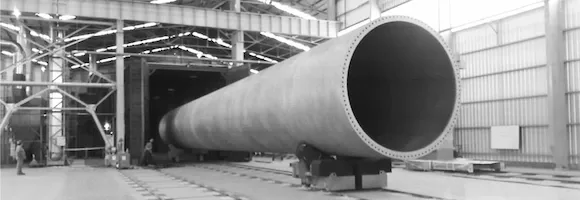
COMPRESSED AIR — flexible, for field work and large parts
- Drives the abrasive with pressurized air through nozzles.
- The abrasive can be conveyed in any direction through hoses.
- Ideal for large parts, complex structures and on-site maintenance.
- With CNC manipulators or robots it allows localized blasting on specific zones.
.webp?dpl=dpl_F2qkM6mUsSWa421zSuLAqV9uxoy4)
CENTRIFUGAL BLAST WHEEL — productive, for continuous lines
- Projects the abrasive by centrifugal force (operating similarly to a fan or a pump).
- The most economical and productive method for automatic, continuous processes.
- Achieves a more uniform surface preparation.
- One or several blast wheels positioned to cover the whole part in a single pass.
Comparative table
The performance difference is striking. To project 1,100 kg (2,425 lb) of abrasive per minute:
| Compressed air | Centrifugal blast wheel | |
|---|---|---|
| Installed power | 1650 HP (compressor) | 100 HP (in 1 or several blast wheels) |
| Operators | 33, with 10 mm (3/8") nozzles at 6.5 kg/cm² (92 psi) | 1 or 2, depending on design |
| Ideal application | Large parts, complex structures, field work | Automatic, continuous production |
The six systems of a shot blasting machine
A shot blasting machine is made up of six systems that work together. The correct operation of each one determines blasting quality, abrasive consumption and machine service life.
1. Abrasive acceleration
The heart of the machine: it projects the abrasive against the part, by centrifugal force (blast wheel) or compressed air (nozzles). Each technology has its application, as seen above.
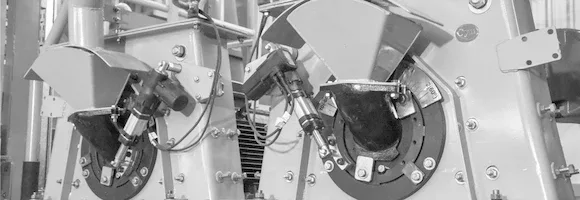
2. Cabinet
Contains the dust and abrasive in suspension during the process. The dust collector keeps the cabinet at a pressure below ambient, so dust does not escape to the surrounding work areas. The part entry and exit openings have seals that retain the abrasive. It is built in low-carbon steel and lined inside with abrasion-resistant materials —rubber, synthetics or high-alloy cast plates—; in direct-impact zones, cast plates outperform all other materials.
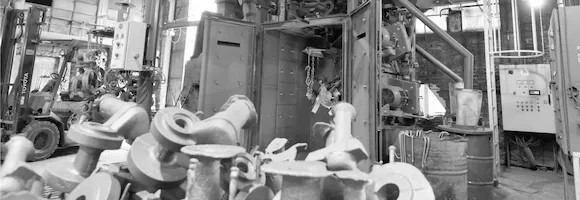
3. Abrasive circulation and cleaning
Recirculates and cleans the abrasive to keep the process continuous. After impact, the abrasive falls into a hopper and a screw conveyor or gravity carries it to a bucket elevator, which lifts it —together with mill scale, oxides and fines— to an air wash separator. There, a combination of screens, deflectors and an air curtain separates contaminants and particles that are too small; the clean abrasive returns to the blast wheel by gravity. Poor operation of this system sharply increases machine wear and abrasive consumption.
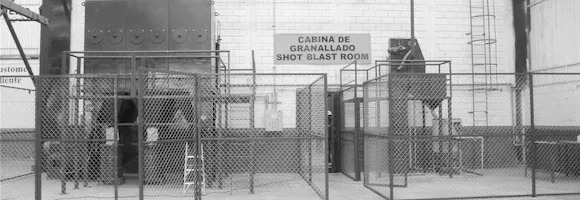
4. Dust collector
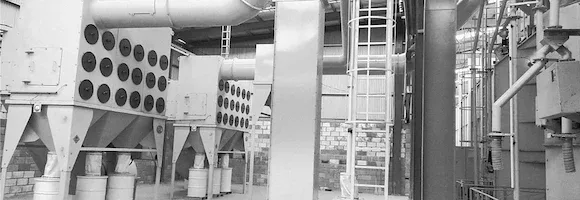
Extracts dust from the circulating abrasive and from the cabinet. The most common is the cartridge type, which also keeps the surrounding areas clean. It generates the airflow that passes through the cabinet and the separator; variations in that flow reduce cleaning efficiency and leave fine contaminants in the working mix.
5. Part handling and support
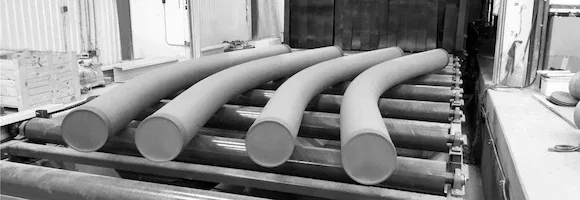
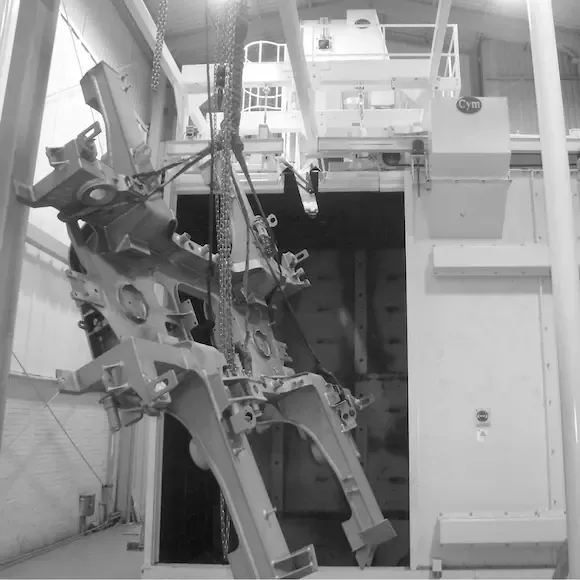
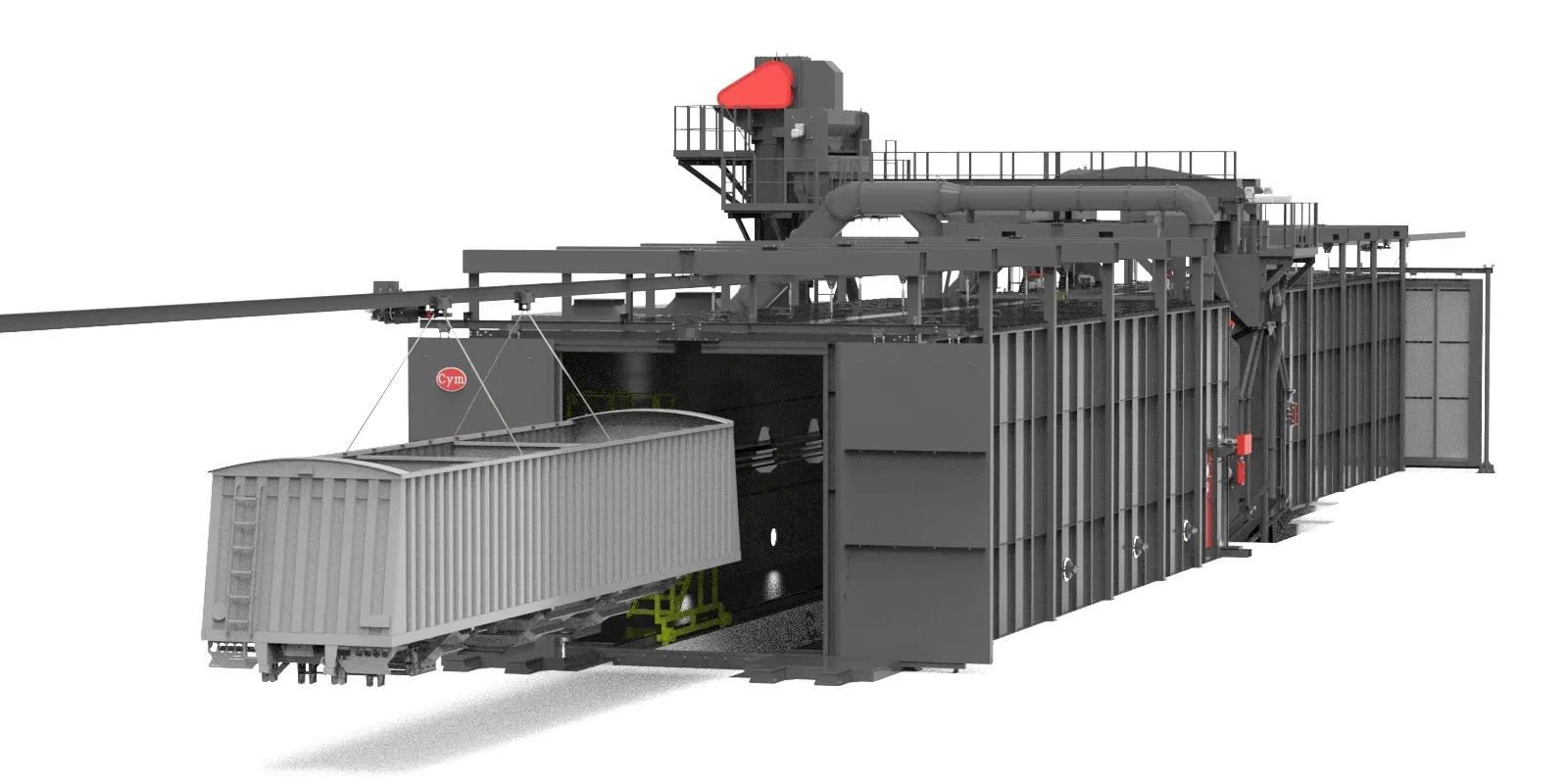
There is a system for every part, from fasteners to railway wagons. Bulk parts (bolts, brake drums, pulleys) are processed in tumble belt machines (tumblast); heavier, larger parts (engine blocks, castings) in spinner hanger or hook (cabinet) machines; and gear shot peening and special jobs in rotary table machines.
6. Controls and instrumentation
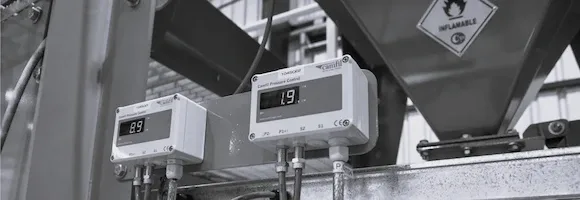
Commands the start and stop of blast wheels, elevators, dust collector and part handling, with ammeters and hour meters for the motors on a central console. The panels include interlocks that ensure start-up in the correct sequence. Almost all machines can be automated for continuous processes, operated by non-specialized personnel and under strict safety standards.
Abrasives
The type of equipment determines which abrasive can be used.
Compressed air equipment works with metallic or mineral abrasives alike (steel shot, aluminum oxide, glass beads, garnet, slag), allowing the most suitable one to be chosen for each job. Centrifugal blast wheel equipment, on the other hand, uses exclusively metallic steel abrasive —carbon or stainless— in various diameters depending on the desired finish.
In enclosed spaces and automatic processes, metallic abrasive offers clear advantages over single-use abrasives:
• Higher productivity and better work quality (uniform consistency, roughness and cleanliness).
• Lower abrasive cost per blasted area, since it is recycled hundreds of times.
• Lower consumption and less waste and dust generation.
• Lower investment in dust collectors and less environmental pollution.
• Better operator visibility and no health risks associated with silica.
Industries and applications
Shot blasting is present across nearly the entire metalworking industry. It is used in foundry and forging, steelmaking and wire drawing, structural steel fabrication, the automotive and auto-parts industry, shipyards, oil & gas, agribusiness, mining, aviation and construction, among many other sectors.
Depending on the sector, the part, the goal and the most suitable equipment change: from mechanical descaling of wires and bars in steelmaking, sand removal of parts in foundries or gear and spring shot peening in automotive, to surface preparation of structures, tubes and cylinders prior to painting.
See the recommended equipment for each sector in detail on our Industries page.
Published: June 2026
KEEP EXPLORING
Related equipment and content
TECHNICAL ARTICLE
Surface preparation before coating
How to do it right for each coating
Read more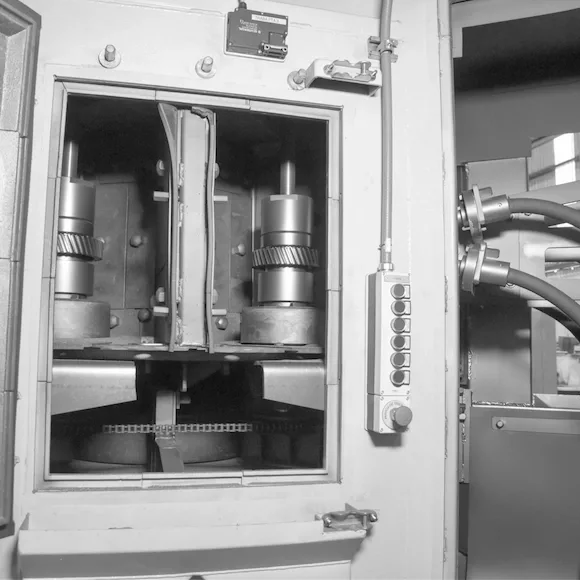
Technical article
Introduction to the shot peening process
Introduction to
the shot peening process
TECHNICAL ARTICLES
How a shot blast wheel works
How the shot stream is generated and directed
Read moreInstallations
Equipment in operation
Videos
Equipment in action
Special Projects
Can't find the equipment you need?
CYM Materiales develops it.
Our Engineering and Sales team works alongside the client to design a custom solution, reducing operating costs and maximizing productivity. Every project starts with a detailed technical assessment and ends with a machine built and tested at our plant
REQUEST A CUSTOM PROJECT